Many people have their own comfort movie for when they feel sad. Some resort to romantic comedies, even if they are super popular movies such as “Mean Girls” or “The Devil Wears Prada”. The choice is huge, but among this spectrum, there is one not-so-well-known work that is not particularly popular but has its own unique charm and will not leave you indifferent. A film that may remain misunderstood but will be remembered. And that is the underrated “The Hitchhiker’s Guide to the Galaxy” by Garth Jennings, based upon the “Hitchhiker’s Guide to the Galaxy” series created by Douglas Adams (one of the screenwriters as well).
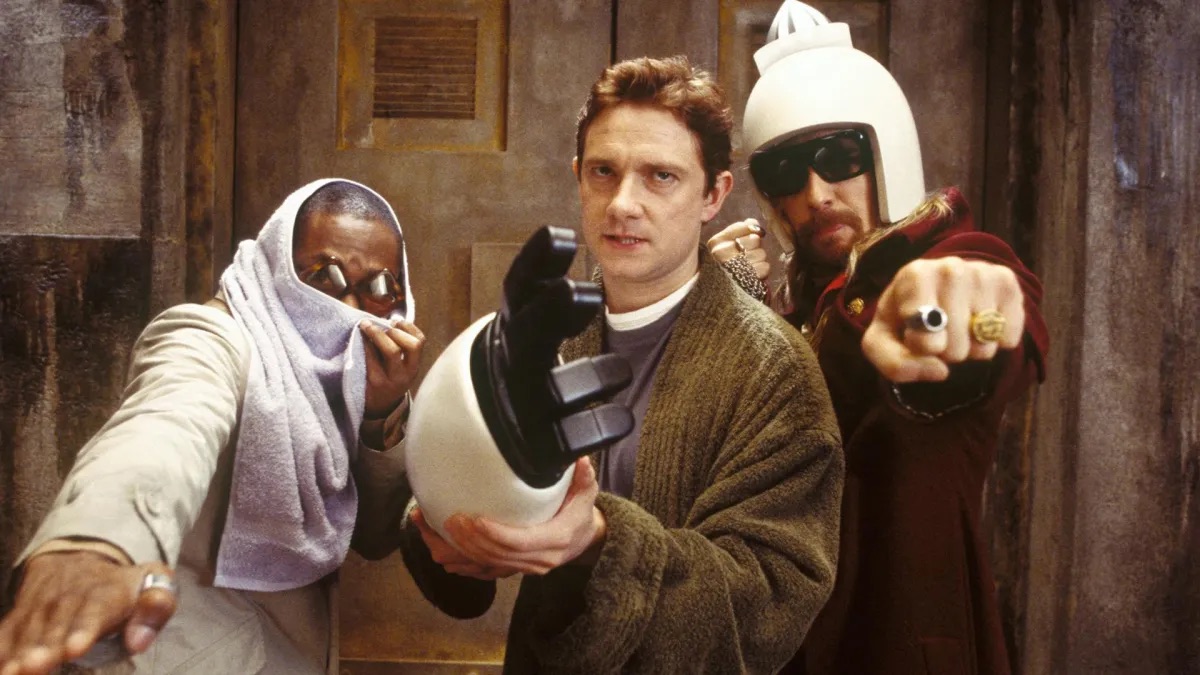
The viewer embarks on a journey through space with Arthur Dent (Martin Freeman), an ordinary Englishman who is saved from the end of the world by his friend Ford (Yasiin Bey). Later, the main character ends up on a stolen spaceship, where he meets the President of the Galaxy Zaphod (Sam Rockwell), a depressed android named Marvin (Alan Rickman as the voice), and encounters a familiar Earth girl named Trillian (Zooey Deschanel). Arthur and his new companions set out to find the meaning of life and answer the question about “Everything”.
The film is based on Douglas Adams’ first novel of the same name: the English writer’s work is imbued with subtle, sharp humor, philosophical absurdism, and a fast-paced plot. It is important to note that Garth Jennings’ film differs from the book, which does not make the film worse or uninteresting. It is simpler, which may seem more understandable than the novel.
There are quite a few differences: from the emphasis on romance to a bunch of digressions in the form of commentary. Therefore, the 2005 film should and must be separated from the book because it also has undeniable advantages that make the film a real “comfort movie.” You won’t get tired of this film even after watching it 10 times.
Let’s start with the humor, which is sharp and witty and permeates the entire film. Already in the first scene, where the viewer is introduced to Arthur and later Ford, who turns out to be an alien and not a human, it is loudly declared that “the end of the world is coming soon.” In the spirit of Edgar Wright’s works, the pub patrons who learn about this don’t particularly care.
An employee even asks Ford, “Should we put paper bags over our heads and lie down on the floor?” And here the viewer immediately understands that this is not an ordinary adventure film where Arthur begins a journey through space. In another story, the news of the end of the world would cause a lot of noise and fuss, but not in Douglas Adams’ universe. Here, the inevitable is accepted with indifference.
Another comical moment is why the Earth is coming to an end: it must be destroyed by building a hyperspace highway. Because of this, the Vogon race destroys all living things, killing an entire planet as if it were nothing. The Vogons, extremely unpleasant creatures, torture the main characters in an unusual way: by having them recite their poems. It’s absurd that such large and vile creatures would read their poems to the bandaged Arthur and Ford, who are so sensitive about their work.
But the epitome of absurdity is the answer to the question of life, the universe, and everything. A huge computer, which calculated the answer for millions of years, came to the conclusion that it is 42. This becomes an irony of philosophy, religion, and science at the same time, when people sometimes strive senselessly for universal truths that are closed to us. This is probably one of the best and most iconic moments in the film.
The humor here is lighthearted; it could be described as friendly and gentle. Even the Vogon race, which viewers may not particularly like, is portrayed in the film as somewhat pitiful creatures. Of course, they may be doomed to destruction, but the film does not mock them. They are simply what they are.
It is impossible not to highlight certain characters, in particular Zaphod Beeblebrox and Marvin. Zaphod is the president of the Galaxy, who rules it in a questionable manner. He is full of selfishness and self-love, but he is also charismatic. His charm won over Arthur Trillian on Earth. The viewer will be interested in watching his amusing actions, gestures, and phrases, making him the cherry on top of the cake in the film. What will he come up with this time? The audience will also remember the android Marvin, who often upsets the heroes rather than cheering them up. His gloomy mood amuses the audience, because if even a robot suffers from depression, then what can be said about the people in this film?
The film is an excellent mix of science fiction, comedy, and romance. Here, the director sends the viewer to explore different planets with their inhabitants, who are not always attractive and kind. The abundance of beautiful space landscapes will appeal to fans of science fiction films. At the same time, in addition to the extraordinary nature of the film, the audience can recognize themselves in the aliens, particularly, how difficult it is to get something without a pile of documents. Bureaucracy is everywhere, even beyond Earth.
Here, characters ranging from Arthur Dent to Trillian do not strive for heroism and are often confused and uncertain. Although Zaphod is the only one who lives for the moment, he is not afraid of being pursued because he stole a spaceship. In the film, the heroes do not save the universe or even want to know the answer to humanity’s most important question. They simply live in the moment, sometimes running away.

The main character does not know what drives him. The future is closed to him, as Earth has been destroyed, and now he has to wander the galaxy in a starship. The world does not punish him for this; his ignorance does not lead to disaster, and he continues on his way. This lack of understanding does not make Arthur a bad or foolish character. Viewers can relate to him, as we ourselves sometimes do not know how to do the right thing or whether it is worth acting now. Dent is not afraid to make mistakes, and in the film, he is not punished for his incompetence.
If viewers are unfamiliar with Douglas Adams’ work, they may find “The Hitchhiker’s Guide to the Galaxy” confusing due to its absurdity, non-linearity, and incomprehensibility. However, the film allows the audience to remain passive. That is, if the viewer misses some detail or does not understand why the group of hitchhikers went to this planet, it will not be a disaster for them. Even after multiple viewings, the audience may be left with the impression that they need to rewatch the film in order to understand everything from A to Z. But that is not necessary here.
It is enough to watch the absurd actions of the characters and even remain confused, as the film allows the viewer to do so. Having received the answer to the main question about the universe, what should be done next? What does 42 mean? The film does not reveal this because sometimes it is necessary to accept strangeness and meaninglessness and continue on your way. The meaninglessness here is the background, not the problem.
The ending of “The Hitchhiker’s Guide to the Galaxy” doesn’t resolve anything in the traditional sense. The universe remains chaotic, the answers remain incomplete, and no grand meaning is revealed at last. Instead of closure, the film offers something quieter and far more comforting: acceptance without explanation. The characters are still confused, still drifting, still unsure of what comes next, yet there is no urgency to fix this uncertainty.
The film gently suggests that confusion is not a temporary failure but a permanent condition of existence — and that life can continue anyway. There is no triumphant victory, no promise that things will improve, only the sense that movement itself is enough. In refusing catharsis, the ending creates a rare feeling of calm: not because everything is solved, but because nothing has to be.
“The Hitchhiker’s Guide to the Galaxy” is an excellent film to lift your spirits or simply have a lot of fun. Its unusual style, which implies the bitterness of actions and the absurdity of characters and their actions, will attract audiences with its non-triviality. Here, strangeness plays into its favor, and even the absence of answers to some questions does not leave the viewer at a loss. After all, it is enough to enjoy the vastness of the immense cosmos together with the amusing characters to see even what you would encounter on Earth. But not without the uniqueness that can only be encountered by visiting other planets.