Maharshi Tuhin Kashyap’s debut feature, “Kok Kok Kookook” (2025), is an absurd film operating under strange by-laws. This is a film where the human body metamorphoses into a machine, both mechanically and philosophically. It is a film where the human and non-human identities collide to question what it means to be a human in an increasingly unstable material world.
But “Kok Kok Kookook” (2025) is not a fantasy or any kind of speculative fiction. It is realistic and challenges the various forms of prejudice subjected to outsiders and the many injustices of the real world. By opening with an investigation into a motorcycle linked to a hit-and-run, the film gradually broadens into a study of social alienation and subjectivity, tracing shifting notions of agency and the uneasy entanglement between humans and objects within a hostile, unstable urban ecology.
Produced by S M Nazmul Haque, “Kok Kok Kookook” tells the story of Nur (played by Raju Roy), a timid chicken seller, living in fear and occupying a marginal position in a city that is defined less by interiority than by the circulation of his labour, favours, and most importantly, his Yamaha RX100 motorcycle. Here, the function of the bike exceeds the mere boundaries of ownership as it becomes an object that shapes obligations and reorganizes his interpersonal relationships. Nur has to repeatedly lend his bike to others to meet the different demands of their needs. And when he refuses, he is forced to comply.
But the situation worsens with the arrival of a police investigation, as it is claimed that a Yamaha RX100 motorbike was involved in an accident case of someone very powerful. The investigation introduces surveillance and anxiety that collapse Nur’s already fragile autonomy. Although his bike is not immediately connected to the accident, Nur gets nervous and tries to hide it through his many futile attempts. In doing so, the film tries to tap into the psychological compression of a person who seems to be living under multiple forms of scrutiny – first, because of his identity and status, and now because of his possession. Soon, he becomes a chicken waiting to be slaughtered.
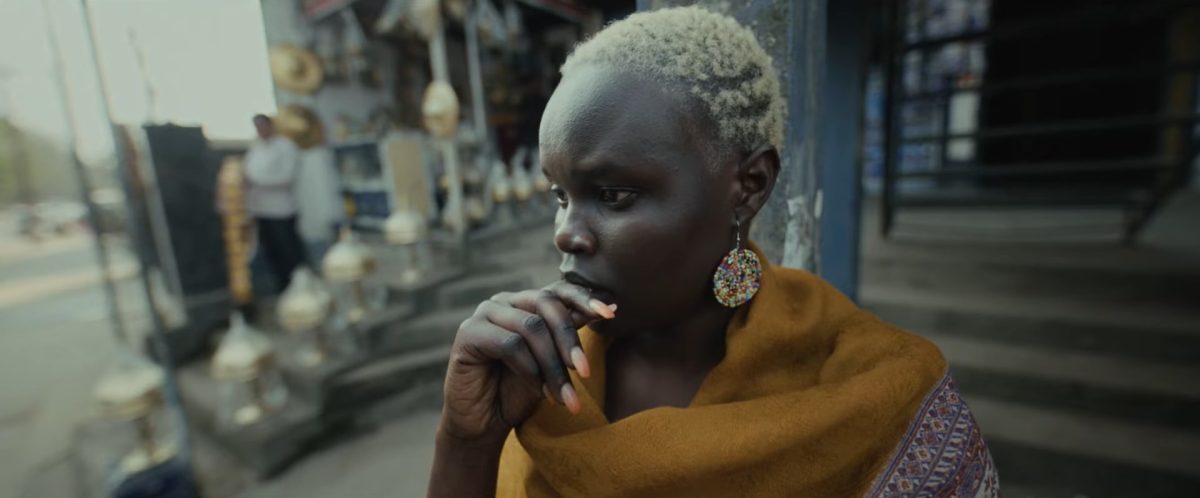
There is also a subplot involving a Black woman, Abebe from South Sudan (played by Esther Jama Paulino Kenyi), who pursues Nur with the hope of becoming the mother to his child. It further destabilizes his ascribed status and identity as the film explores the grounds of love and desire. And in this process, the city stands as a non-neutral backdrop—an indifferent system that absorbs Nur’s body, labor, desire, and finally his ontology.
In its tonal and philosophical orientation, “Kok Kok Kookook” (2025) recalls the deadpan estrangement of Aki Kaurismäki’s working-class protagonists, the bureaucratic dread of Kafkaesque cinema, and the corporeal metamorphoses of films such as Yorgos Lanthimos’ “The Lobster” (2015) and Julia Ducournau’s “Titane” (2021), while remaining rooted in a distinctly Indian socio-political and cultural landscape. Nur’s meekness, his habitual compliance, and the fear of authority can be read along the contemporary Indian discourses where minority subjects are often positioned as perpetually answerable, hyper-visible to surveillance, and politically disposable.
Nur’s body and belongings become sites of suspicion rather than protection. But he is not persecuted through force or violence. It is through an ambient pressure of the psychology that the authority functions, which turns out to be the lived reality of many minority communities today. Hence, the absurd also becomes the political, exposing how the marginal lives are quietly re-shaped by the various structures and systems that they have neither designed nor fully comprehend.
Kashyap’s direction is also attentive to the ambiguity of identities: no character is villainous, yet every interaction contributes to Nur’s existential unease. When Nur literally transforms into a motorbike, with his face sealed shut forever, the film’s objective and intention go beyond providing a resolution so that it can present itself as a philosophical debate, suggesting how citizenship itself risks becoming conditional in the hands of the state. His transformation into an object, a motorbike, signifies this very aspect, as his new self can be seized, used, or discarded at the will of those who hold power.
The uniqueness of the film is that it works around a post-humanist framework to foreground the combination of such ideas and situations where human identities merge with the material ones. A living and breathing body gets converted into an object that doesn’t have an agency of its own. Nur no longer represents the subject who used the motorbike; he is absorbed into it, and that defines his new identity. It is also an unsettling reminder that in the late-capitalist urban life, the boundary between the person and thing is not broken, but it was never secure to begin with.
Locating “Kok Kok Kookook” (2025), which was previously screened at the 30th Busan International Film Festival (BIFF), within the larger ambit of Indian cinema, it can be said that the film falls more in line with the experiments of Amit Dutta or the more popular “Ghode Ko Jalebi Khilane Le Ja Riya Hoon” (2019) by Anamika Haksar or the metaphysical spirit of films like “Ship of Theseus” (2012). This is because films engaging with surrealist and absurdist tendencies or any heavy philosophical exploration of the self and identity always remain confined to a niche within the broader range of the Indian film landscape.
Maharshi Tuhin Kashyap’s film extends this position of marginality and pushes it further. This is why it feels like watching a film that is much ahead of its time. It is not only because of his post-human imagination but also because of the confidence that he bestows upon Assamese cinema that it too can function as a site for radical philosophical experimentation.
For common audiences in the regional sphere, this particular kind of cinema is likely to generate a sense of discomfort. And this friction may end up limiting the film’s immediate accessibility, but it also marks a political and aesthetic insistence, that is, to challenge the viewers and confront the various experimental forms of cinema that exist out there.
Even if not today, time will surely reward the film and the filmmaker in the future. “Kok Kok Kookook” (2025) is shot by Shingkhanu Marma, edited by Sadang Arangham, and composed by Bhaskar. A final year diploma project produced by the Satyajit Ray Film & Television Institute (SRFTI), India, the film was also screened at the 30th International Film Festival of Kerala (IFFK).




![Rim of the World Netflix [2019] Review – A childish throwback to the 80s](https://www.highonfilms.com/wp-content/uploads/2019/05/Rim-of-the-World-Netflix-Original-2019-768x432.jpg)