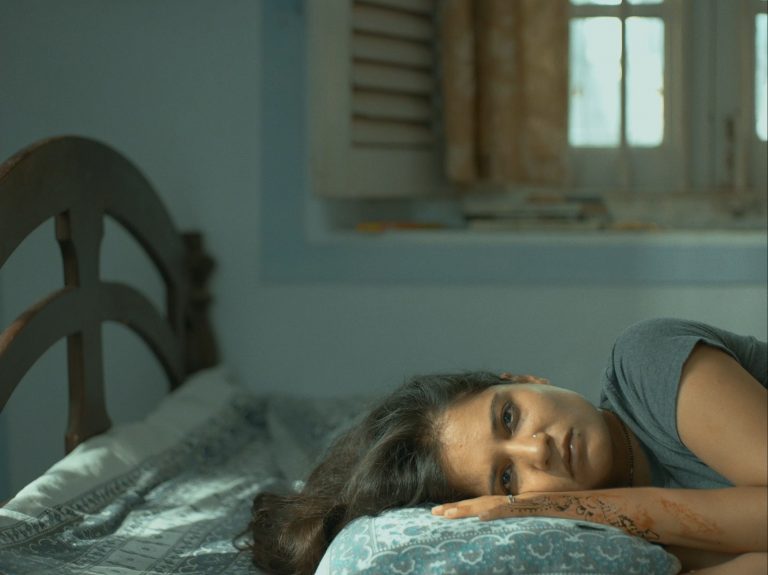
In the quiet, crowded arteries of Bengaluru’s old trading district, where shop signs jostle for space above narrow lanes and commerce moves with the rhythm of inherited habit, “Mehta & Co.” unfolds a patient observation of emotional residue, the kind that settles in places long before anyone realises it has begun to accumulate.
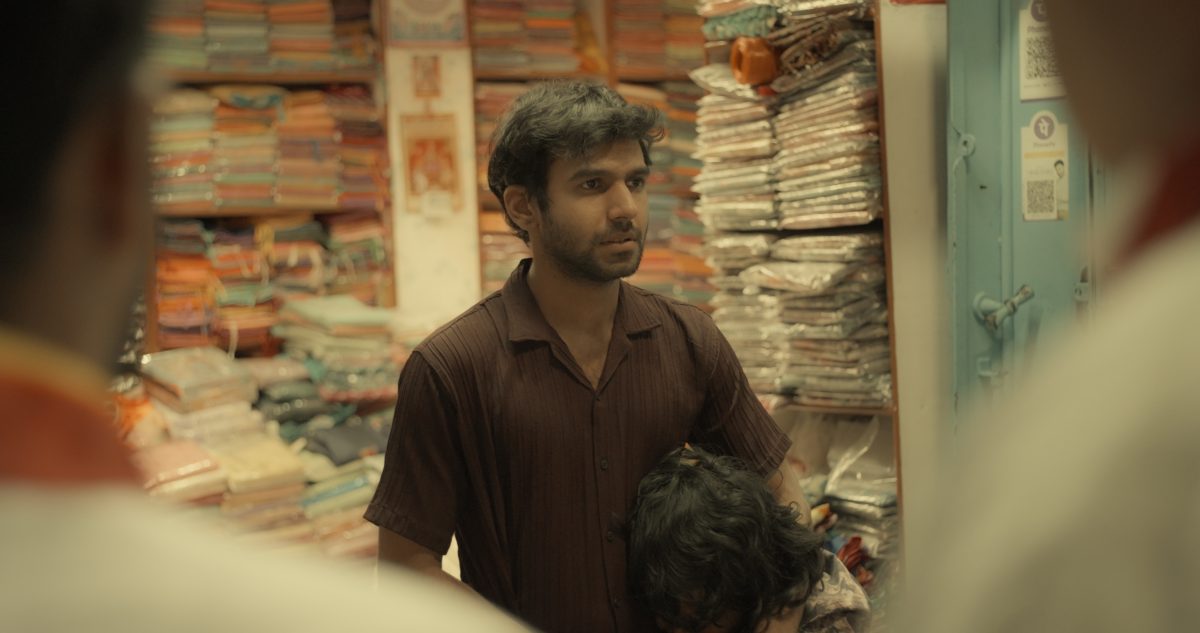
The film situates its central character, Ravi, within the modest saree shop that gives the film its title, a business he inherits less through desire than through the silent inevitability that often accompanies family enterprises. The shop itself becomes less a workplace than an archive of gestures, objects, and absences. Its wooden shelves, folded fabrics, and fading signboard carry the weight of a life once lived by Ravi’s father, a presence that lingers even after the man himself has receded into memory.
The narrative’s quiet force arises from the way it observes Ravi’s uneasy proximity to this inheritance. He moves through the shop with the distracted rhythm of someone who occupies a space without fully belonging to it, performing the rituals of selling and arranging without quite engaging with their meaning. Such distance does not appear as rebellion so much as emotional fatigue, the kind that grows in relationships where affection never found the vocabulary to express itself.
What becomes particularly striking in “Mehta & Co.” is the way the father’s presence gradually emerges through a quiet constellation of traces that seem to linger in every corner of the shop. The film relies on the material environment to perform that work. The saree shop itself begins to resemble a living document of the father’s habits, preferences, and rhythms of life.
Customers who enter the shop casually refer to the father with familiarity, sometimes recalling small incidents or old transactions, and in those brief moments, the film allows the audience to glimpse the social world he once inhabited. The father becomes legible not through narration but through recognition. Other people remember him even when Ravi appears uncertain about how to remember him himself.
In this way, the community surrounding the shop functions almost like an extended memory system, preserving fragments of the father’s character through anecdotes, habits of address, and the easy confidence with which long-time buyers step inside expecting the same reliability they once associated with the Mehta name.
This indirect construction of the father produces a particularly subtle emotional effect. The film shows how the absence of someone can reorganise everyday life in quieter, more ambiguous ways. Ravi continues to open the shutters, arrange the sarees, and respond to customers, yet these actions carry an air of detachment, as though they belong to a routine that persists independently of his emotional engagement with it.
What emerges here is a form of grief that settles into the body as hesitation, fatigue, or an inability to feel invested in the future of the place. The shop, therefore, becomes a space where absence is constantly felt but rarely articulated. Every task Ravi performs seems faintly haunted by the knowledge that someone else once performed it with greater certainty.
In that sense, the father’s absence generates a peculiar kind of inertia. Ravi does not actively reject the inheritance of the shop, yet neither does he fully inhabit it. He moves through the space with the quiet restraint of someone who has not yet discovered how to translate inherited responsibility into personal meaning.
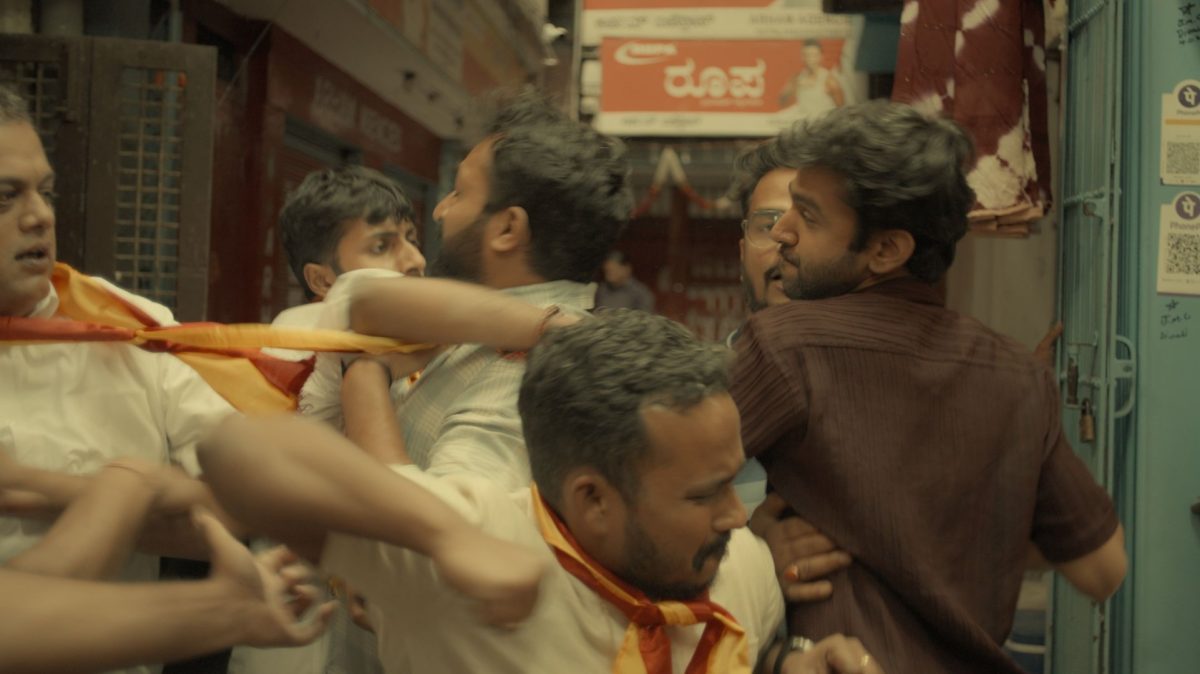
At one point, the shop’s signboard becomes the site of a small act of vandalism by a language enforcement group, an incident that initially appears political but gradually reveals itself as a catalyst for something more internal. The damaged signboard becomes a moment where Ravi is forced to recognize that identity, like inheritance, often exists outside individual choice. For families who have migrated across regions in pursuit of trade, such as the Marwari community to which Ravi belongs, belonging frequently occupies an uneasy space between familiarity and negotiation.
Over time, this accumulation of traces begins to alter Ravi’s relationship to the shop in subtle ways, and the routines that once appeared mechanical or burdensome slowly begin to disclose a deeper internal order. These realisations do not arrive as dramatic epiphanies but as gradual adjustments in perception, almost as if Ravi begins to learn the grammar of a language he had previously spoken only unwillingly. Yet this slow recognition unfolds alongside another tension that quietly shapes the film’s atmosphere of unease surrounding linguistic belonging within the city.
In “Mehta & Co.,” the shop exists within a marketplace where language functions as both everyday communication and cultural boundary. Ravi, as a member of a Marwari trading family long settled in Bengaluru, inhabits a space that is economically embedded within the city yet socially marked by difference. The moment when the shop’s signboard becomes the target of linguistic vigilantism, and its lettering is contested by those insisting upon the primacy of the regional language, it reveals how fragile that belonging can be. The shop’s name, inherited from the father, therefore begins to carry a double burden. It signifies familial continuity while simultaneously marking the family as outsiders within the linguistic politics of the city.
This tension between inheritance and non-belonging begins to echo Ravi’s personal grief in unexpected ways. Just as the father’s absence creates a quiet emotional dislocation within the shop, the city’s language politics produces a subtler form of spatial dislocation, reminding Ravi that the very enterprise his father built over decades occupies a precarious cultural position. The grief he carries thus begins to intersect with a larger awareness of displacement. The shop becomes a site where two forms of inheritance converge.
The intimate inheritance of a father’s life alongside the historical legacy of migration, as communities arrive in new cities seeking livelihood, yet remain aware of their partial acceptance. The vandalised signboard captures this intersection with striking clarity. On one level, it registers as an act of hostility directed at linguistic difference; on another, it forces Ravi to confront the deeper question of what it means to continue a legacy in a place that may never fully recognize it as its own.
The film suggests that understanding a parent’s life often happens retrospectively, after the possibility of direct conversation has already vanished. In such circumstances, the material remnants of that life, like objects, spaces, and habits, become the only language through which recognition can occur.
Within the shop of “Mehta & Co.,” therefore, grief suspends him in a state of waiting, where meaning slowly reveals itself through the ordinary details that surround him. The father remains absent, yet the world he built continues to operate, quietly inviting Ravi to discover whether he can eventually find a place within it.



![Repast [1951] Review – A Wonderfully Subtle Marital Strife Drama](https://www.highonfilms.com/wp-content/uploads/2020/11/Repast-1951-768x432.jpg)
![Terrorizers [2021]: ‘TIFF’ Review – A look into cyberspatial nightmares](https://www.highonfilms.com/wp-content/uploads/2021/09/Terrorizers-1-highonfilms-768x384.jpg)