Martin Scorsese’s “The Departed” (2006) stands as a masterpiece. It is not just because of its killer script, but because of how deeply it interrogates power and legacy. Beneath the surface of this cops and robbers style thriller, lies a story about men who are searching for fathers, performing acts of violence, and slowly rotting from the inside. It is a film about guys who might be able to act tough, but they are morally confused and spiritually lost. In that sense, “The Departed” is not just a remake of “Infernal Affairs”. It is one of Scorsese’s most personal statements about America and corruption.
It’s arguably his best film of the 2000s, capping off a career that remarkably produced at least one masterpiece per decade. Scorsese is one of my favorite directors, and I would say “The Departed” is one of his strongest. Part of that is in the editing; the way this movie flows, it is very smooth. I would also recommend watching “After Hours” (1985), which is different in tone, showcasing Scorsese’s versatility as a filmmaker.
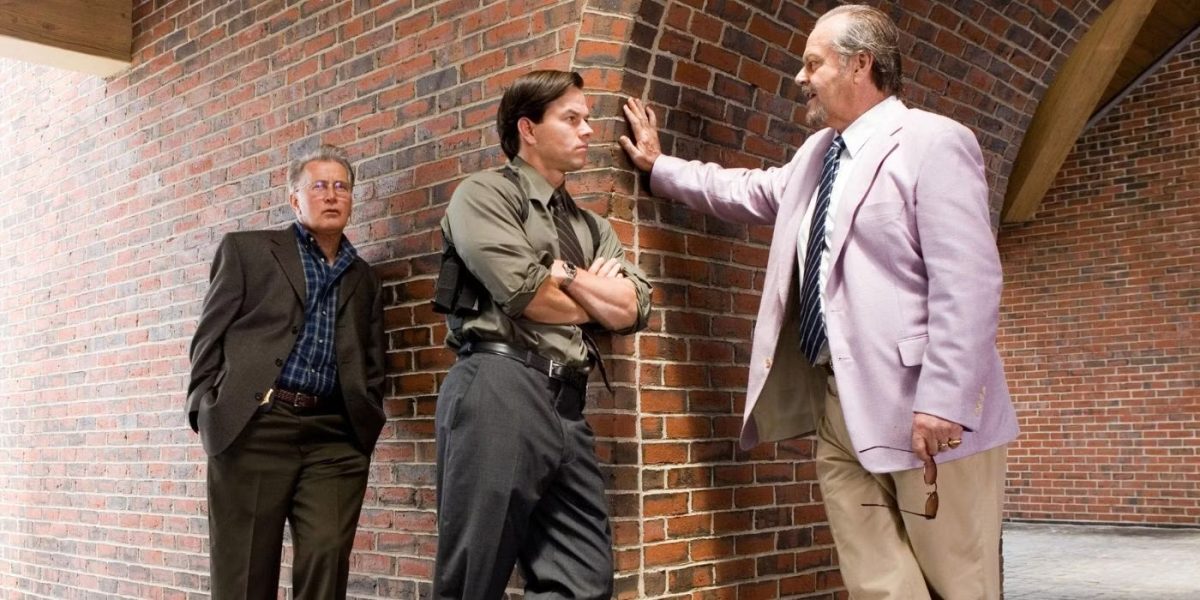
At the center of this film’s legacy is an incredibly wild performance by Jack Nicholson as Frank Costello. He plays a crime boss, who feels less like a character and more like an embodiment of American nihilism. Costello doesn’t just commit crimes. He philosophizes about them and embodies a Nietzschean morality.
There are also references to different writers throughout the film, like Sigmund Freud, James Joyce, and Nathaniel Hawthorne. Costello’s speeches, often rambling and profane, are laced with warped wisdom about strength. “I don’t want to be a product of my environment. I want my environment to be a product of me.” Costello says at the start of the film. These monologues are some of the most quoted moments in the movie. Costello’s fixation on power is revealing of his mindset.
This theme reaches its most tragic expression in Matt Damon’s character, Colin Sullivan. Damon plays him as a man who has mastered the performance of success, a nice apartment, a respected job, and a beautiful girlfriend, but he is internally frozen and impotent. It is hinted that Colin cannot perform in the bedroom, and the film makes it clear that this is not just stress; it is identity failure.
He doesn’t know who he is because his entire self was shaped by Frank Costello. Costello is his father figure, mentor, and moral compass, and that is precisely the problem. Although Frank says, “When you decide to be something, you can be it.” Colin never chose his life, but instead he inherited a lie.
Damon’s performance is great because it avoids hysterics. He is emotionally numb. Until the scene in the end, in the elevator, when he begs for a brief moment to be killed. His impotence in this film reflects his inability to connect honestly with anyone, including himself. This is in contrast to Leonardo DiCaprio’s character, who is emotionally unraveling and wants to live an honest life. His intentions are to help society and break out of his troubled family roots. Both characters are damaged, but only one of them still feels pain, and “The Departed” suggests that the ability to feel pain is what keeps you human.
Leonardo DiCaprio’s performance as Billy Costigan is great. Billy is the opposite of Colin in every way. DiCaprio plays him as a man who is unraveling in real time as his circumstances get more dangerous. Billy is undercover in the mob, but unlike Colin, he never stops knowing who he really is. Billy’s search for father figures is central to the tragedy. He is passed from one substitute father to another: Queenan, Dignam, and even Costello himself, in a twisted way. Each represents a different version of authority and aggression, but none can actually save him. The system uses Billy until there is nothing left.
Also Read: The 10 Best Leonardo DiCaprio Movie Performances
DiCaprio’s performance makes this electric. His panic attacks, paranoia, and barely contained rage are not just plot devices. They are the physical symptoms of a man whose identity is being crushed by indifference. He wants his real identity back. Billy deeply affects Dr. Madolyn Madden, played by Vera Farmiga, whom he meets with to discuss his PTSD. Madolyn cries at his funeral after he passes away. The ending implies that she is pregnant with his son. Although Billy could not be saved from his environment, his pursuit of a noble cause ultimately led him to a noble ending, with a continuation of his legacy, unlike the criminals that haunted him.
Mark Wahlberg as Sergeant Dignam is often remembered as comic relief, but his role is crucial to the film’s moral logic. Dignam is a bad talker, profane, openly hostile to Colin and Billy, but he has a good heart. He never pretends to be something he’s not. He is honest in his intentions and deeply committed to justice, even if his methods are crude. In a movie filled with guys who hide behind masks, Dignam’s lack of polish becomes a form of integrity. That is why Dignam wins in the end.

His execution of Colin is not framed as a heroic triumph, but it is framed as a moral resolution. He is not corrupted by the system in the same way as the others because he never plays the game. You can’t lose a game you refuse to play. As soon as Queenan is thrown from the roof by Costello’s goons, Dignam immediately resigns and disappears until his surprising final appearance. Scorsese seems to argue that in a world built on lies, blunt honesty, even when brash, is the closest thing to virtue.
“The Departed” is the bridge between Scorsese’s classic crime operas and later moral epics. The film won four Academy Awards: Best Picture, Best Director, Best Screenplay, and Best Editing. It was a smash hit and a box office success for good reason. It captures the sense of distrust that permeated America in post 9/11.
We also can’t forget the way the characters say microprocessors. The pacing of this film is excellent, with scenes flowing naturally and at a fast pace. “The Departed” argues that in a system built on mistrust, the tragedy isn’t that everyone betrays each other, but that no one learns another way to live. “All of that murdering and no sons?” yells Colin to Frank at the end of the film.
“The Departed” endures because it refuses easy moral comfort. Almost everyone loses. The guys who talk the most are the emptiest. No one knows who to trust. The guys who feel the most die the worst. And the one who survives long enough to deliver justice does so alone, off the books, without applause. In a film about rats and masks, Scorsese suggests that the real tragedy is not betrayal, it is inheritance. We become what our fathers teach us, unless we are brave enough to break the cycle.


![Ghosts of the Abyss [2003] Review: An Unscripted Adventure Back to Titanic](https://www.highonfilms.com/wp-content/uploads/2019/03/ghosts-of-the-abyss-screenshot-1-768x432.jpg)