It’s immediately clear in “The Housemaid” that the film deliberately manipulates its tone to catch viewers off guard, as the dialogue and plot progression are far too blatantly absurd to be taken at face value. Moments of foreshadowing are so obvious, and performance choices are too distracting for “The Housemaid” to be played straight.
Still, the question is whether these declarative directorial decisions have any value other than inherent subversion. Unfortunately, “The Housemaid” is far too messily plotted to be enjoyed care-free, and makes enough derivative choices that it overstays its welcome. There are some strong performances in “The Housemaid,” but the film can’t get over the awkward union of director and material.
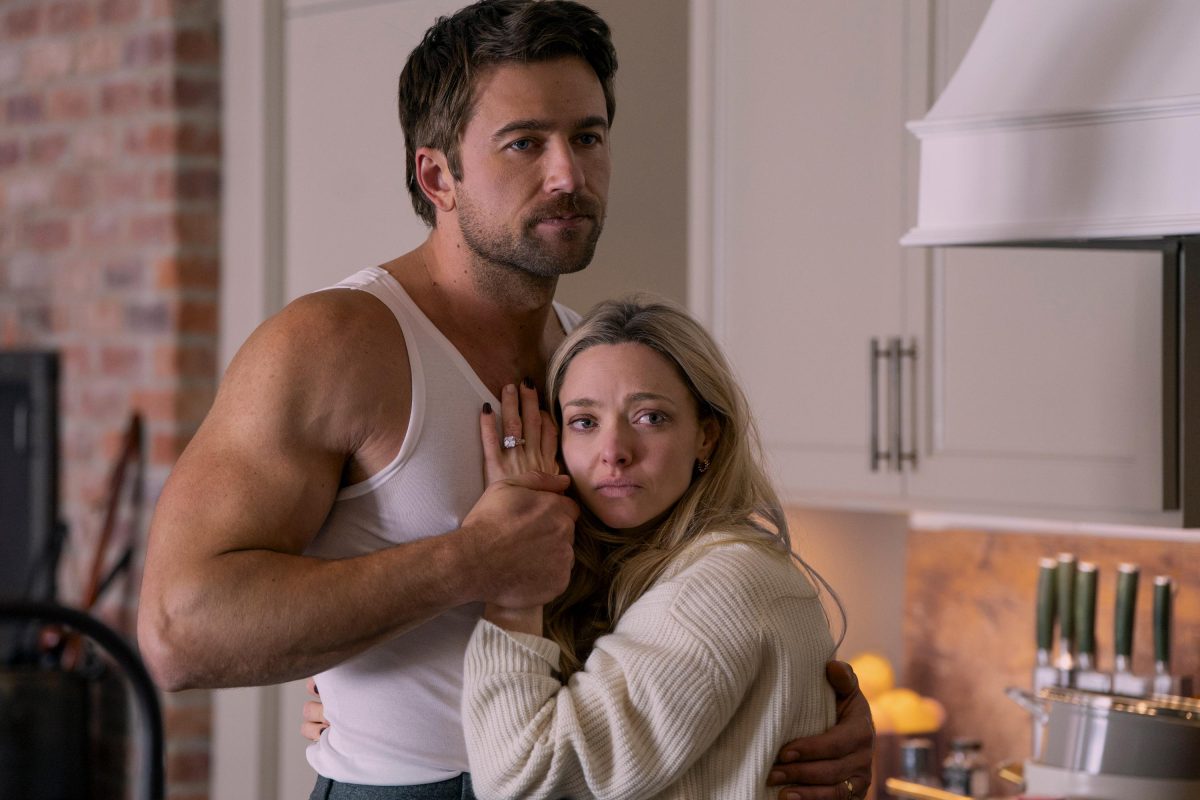
Based on the bestselling novel of the same name by Freida McFadden, “The Housemaid” follows the young, unemployed woman Millie Calloway (Sydney Sweeney), who fakes a resume to interview for a housemaid job with the wealthy woman Nina Winchester (Amanda Seyfried).
Although Millie is almost certain that the well-meaning, enthusiastic persona Nina has is a guise, she’s shocked when she’s hired to start immediately. Millie struggles to connect with Nina’s daughter, Cecilia (Indiana Elle), but does form a bond with her husband, Andrew (Brendan Sklenar). However, Millie’s seemingly perfect job becomes a nightmare when she discovers that Nina is psychotic, demanding, and adamant in tormenting her.
“The Housemaid” quickly dispenses any semblance of reality, making it ineffective as a satire. Although there are a few heavy-handed moments that point out the narcissistic, self-absorbed nature of wealthy parents, Nina’s cadence and rhythm become so over-the-top that her actions are clearly anticipating a twist. The issue is that Nina’s state of mind is almost instantly distorted, leaving little time in which she can form any earnest connection with Millie. As the story complicates, the chance to develop any degree of emotional integrity is a major misfire.
“The Housemaid” finds itself at an interesting crossroads between the self-aware suburban mysteries of the post-”Gone Girl” era and the sort of heightened psychological thriller common in the ‘90s. However, the sort of knotiness within “Gone Girl” isn’t possible for “The Housemaid” when each of its maneuvers is so clearly orchestrated.
The lack of subtlety shown when hinting at the dark secrets held by any characters turns the film into a game of guessing what form the inevitable rug-pull will be, instead of being shocked by it. While this might have been pleasurable had the film backed up its stylization with genuine shocks, the more lewd and off-color moments in “The Housemaid” are surprisingly tame, overworked moments of excess.
The reveals are also so misguided in execution that it’s almost insulting, as there seemingly can’t be a single moment of character development that isn’t confirmed by a blatant declaration of purpose or an extended flashback that pencils in far too many details. There’s no reason that a pulpy, trashy thriller should be longer than many of the year’s top Oscar contenders, especially when considering that “The Housemaid” is a rather confined story with only a handful of characters. This is particularly glaring within the third act, in which an extended detour grinds the pacing to a halt and undercuts what could have been a gleefully madcap finale.
Also Read: 20 Great Psychosexual Movies That Are Worth Your Time
Perhaps a film like “The Housemaid” was never intended to be entirely sound in logic, but there’s a difference between scouring for plot holes and pointing out blatant gaps in the narrative that make the characters less engaging.
Although there are some parameters that are ridiculously over-explained (such as the reason why Millie feels she can’t quit her new job), others are justified in such convoluted ways that the defiance of rationality is cumbersome. There are only so many suspensions of disbelief that can be allotted, and “The Housemaid” makes the mistake of heaping bizarrely contrived narrative choices upon a series of motivations and payoffs that are surprisingly conventional.
What makes “The Housemaid” engaging, at least in its first two acts, is the performances, as both Seyfried and Sklenar in particular seem to understand the tone that the film should have been pitched at. Seyfried is shackled with such an uneven and ultimately unrewarding role that it’s a minor miracle that she’s able to chew so much scenery early on. If anything, Seyfried finds a degree of specificity that suggests Nina’s abnormalities are nothing more than personal idiosyncrasies.

Alternatively, Sklenar is asked to play the well-meaning, unreasonably dashing husband and father with a degree of plastic perfection that is frequently comical in its misdirections. Since there’s no expectation that Andrew is a character who is exactly what he appears to be, Sklenar is able to bask in the ridiculousness of the idealized persona. While Sklenar is most famous at this point for his smoldering, charismatic turn on “1923,” “The Housemaid” suggests he might have the same ability to play with expectations as a Brad Pitt or George Clooney-type actor, given that he receives better scripts.
Sweeney’s performance is almost relentlessly uninteresting because Millie is an instinctively passive character who is too often asked to simply emulate the reaction that an intended audience member should have. The unpacking of her backstory comes too late (and is foreshadowed too heavily) for her to generate any degree of empathy, especially when considering it’s not much different than other recent performances Sweeney had given.
Sweeney can’t really be blamed for having the least-fun part in what should be a guilty pleasure, but she’s also given more to do than her co-star Michele Morrone, whose talents are wasted on a vastly underwritten character whose prominence within the final act is completely unearned.
Many of the confused hijinks and tonally obtuse moments in “The Housemaid” might have been forgiven if there was ever a real sense of tension, or at least genuine mean-spiritedness, but the reality is that Paul Feig is simply not up to the task.
Feig showed a lot of promise as a comedy director with contemporary classics like “Bridesmaids” and “Spy,” but he’s spent the last decade making unusually contrived, uneven genre pieces in which the characters simply act in a way that feels inhuman. “The Housemaid” is far more watchable than his efforts on “Ghostbusters” or “Last Christmas,” but it leaves a surprisingly sour taste for a film with such little substance.







![Lost Girls [2020] Netflix Review – An unfocused take on police ignorance and a plea for justice](https://www.highonfilms.com/wp-content/uploads/2020/03/Lost-Girls-Netflix-highonfilms-768x432.jpg)