Mainstream Hollywood has a shaky history in dealing with stories centered around queer characters. For years, they received a spotlight in indie circles, but were usually deemed as outliers by the media. There was a noticeable shift in the recognition they received in the past decade, but some of these projects had their own issues. One such example is an Oscar-nominated film by a French director about a trans woman, which tried to explore her identity struggles, but failed because the filmmaker was out of touch with his own subject. That is far from the case with the deeply personal story we get to see in “The Serpent’s Skin,” the latest feature film from Alice Maio Mackay.
Directed by Mackay with a script she wrote along with Benjamin Pahl Robinson, the film centers around Anna (Alexandra McVicker), who leaves her hometown to escape her painful past. The script doesn’t offer us much to understand the root of her despair in its initial moments, besides a heated argument between her parents.
Based on their interaction, one of them seems woefully apathetic, comparing their struggles with hers, thus decentering her from these conversations. That leaves us wondering whether her decision to leave home was simply out of her teenage blues. The film takes a subjective approach to unpeel its further layers, revealing Anna’s struggles as a trans woman.
Mackay offers an insight into Anna’s mind through subtle changes in her behaviour as she steps into a new environment. The introduction presents her as quite shy, afraid, and aloof. Yet, the moment she steps into the new town, she immediately seems far more comfortable in her own skin. It becomes even more evident as she moves in with her older sister, Dakota (Charlotte Chimes), and strikes a chord with her neighbour, Danny (Jordan Dulieu), within a matter of hours. Then, in the next few days, she finds a job at a record store and gets into a relationship. All of this happens seamlessly, without her needing to make much of an effort.
These minor details reveal much of what we need to know about her emotional arc. In every connection she makes, people accept her without judgment or trying to mold her into their idea of who she should be. That cuts a little deeper through the trans lens employed throughout the narration. Every choice or supposed transgression that she makes is parsed through this lens, analyzing emotional comfort against oppressive rigidity.
It goes in line with a strong undercurrent of counterculture noticeable throughout the film’s duration, with posters of Nick Cave and Alice Cooper in their heyday on the walls, and the film’s entire aesthetic approach leaning heavily on neon lights, while putting socially alienated characters at the forefront.
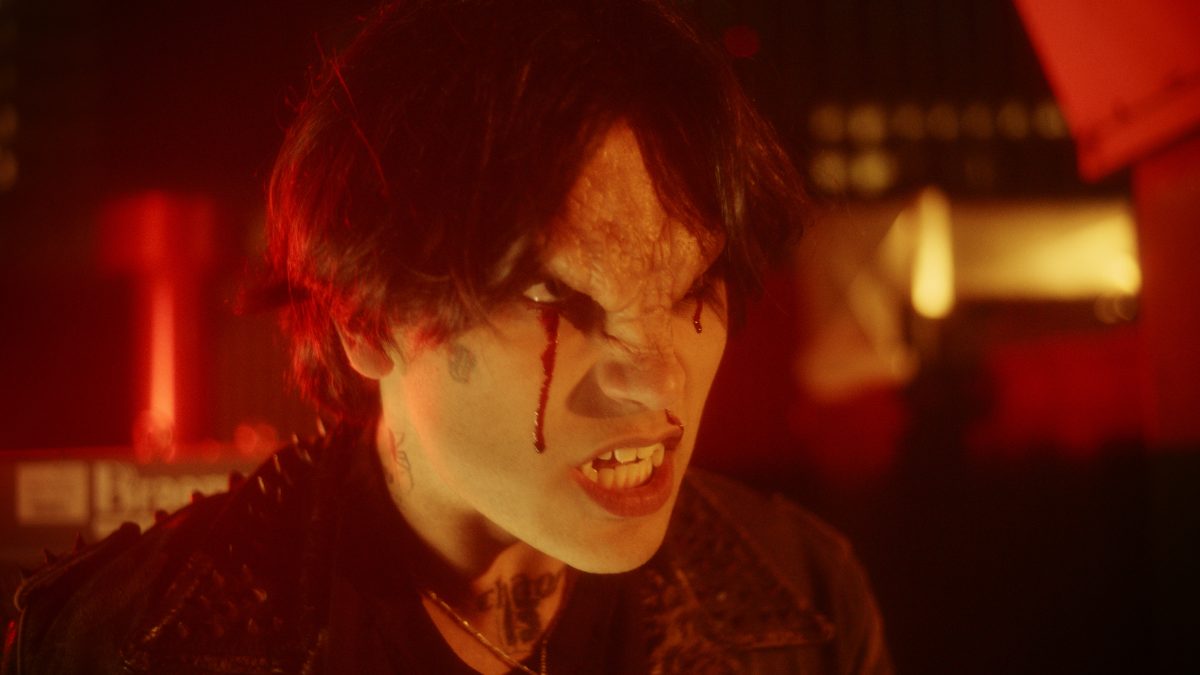
It all plays a part in projects like this, largely defined by their peculiar melancholy mood. Mackay builds it by introducing lo-fi, hypnagogic pop soundtracks that maintain a dreamy, otherworldly surrealism with a nostalgic undertone, while grounded in its psychedelic musical roots. She pairs them with occasional slow-motion or superimposed shots that gel perfectly with its supernatural themes. While introducing aspects of witchcraft for some visceral genre thrills, the script utilizes them for its overarching allegories about gender roles and constraints.
Thematically, the script isn’t dense, leaving its resolution to seem predictable. On the genre front, it doesn’t step too far from the usual beats either and feels like a Gen-Z riff on projects like “Practical Magic.” Some of its central characters appear as representations of certain tropes, whether it’s a nosy neighbor in boho outfits, a record shop owner who looks like present-day Fred Durst, or a criminal who looks like every problematic rapper cosplaying as Eminem.
Leaving them to those descriptors has its own advantages and disadvantages. On the plus side, it allows more room for Anna and her girlfriend, Gen’s (Avalon Fast), evolving relationship to be the sole focus, showing every detail only through their perspective. On the flip side, it keeps Anna’s relationships with Dakota and Danny underdeveloped, leaving their concern or emotional investment in her rather one-dimensional. Besides that, visually, the film has its charm, thanks to some of its striking frames. Yet, it could have had a stronger visual identity beyond its derivations of a trending aesthetic.
There’s still beauty that the film captures through everyday moments between Anna and Gen, some of which include them being vulnerable and sharing heartbreaking, intimate details about their past. McVicker and Fast have strong chemistry as a romantic couple, which enhances the strength of their individual performances.
They sincerely capture the haunting nature of their characters’ anguish, as the comfort of their co-existence slowly pulls them out of it. More importantly, it encapsulates the experience of living as a trans person without being reductive about it. Instead, it reinvisions the witchcraftian genre projects by putting Anna at the centre, leaving us with a visceral and vastly absorbing experience.



![The Scars of Ali Boulala [2021]: ‘Tribeca’ Review – The highs and lows of a skateboarder](https://www.highonfilms.com/wp-content/uploads/2021/06/The-Scars-of-Ali-Boulala-1-highonfilms-768x432.png)
![November [2018] – A Peculiar and Aesthetically Striking Tale of Unrequited Love](https://www.highonfilms.com/wp-content/uploads/2018/02/Nov-cover-768x513.jpg)