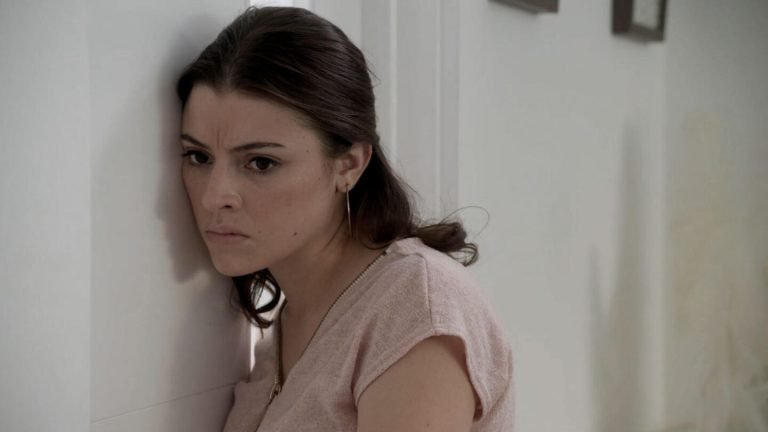
Slavoj Žižek, in “Violence: six sideways reflections”, argues for a three-layered model of violence – subjective, symbolic & systemic. Perhaps my recent study of Žižek’s exploration of violence works as a lens to read Anubhav Sinha’s recent social commentary-laden crime drama “Assi.” Sinha, being Sinha – one of the bravest voices in contemporary filmmaking in India – deals with yet another sensitive subject: rape, which is taking place, as if compulsively, at regular intervals (within a span as little as twenty minutes approximately) in some corners of this country.
A bloody screen, inscribed with the condition of women in 21st-century India, initiates the film and appears every twenty minutes – this arguably is a major effect, used by a filmmaker in recent times, that doesn’t let us forget the political status quo, which also works as the backdrop of “Assi,” making the film a quasi-real visual imagery that explores a particular social situation where thousands of women are being throttled every twenty minutes, and also, in a way, represents a counter-narrative to the established symbolic language of violence by abiding Žižek’s arguments.
“Parima” (Kani Kusruti) has been raped by a pack of wicked creatures – one of whom goes to the extreme of thinking, with certainty, that the victim must be enjoying herself while being deflowered. One makes a video; one is a practitioner of marital rape; and another is worried about the probable aftermath of all this, which he fears might reach his father’s ears … which, ultimately, indeed happens and makes his wealthy father negotiate in a low-key manner with the system (abiding by Žižek’s final layer of violence – ‘systemic’). However, all this takes place inside a car amid a busy street, making us realize how a vicious crime occurs with a degree of normalcy; how effortlessly one can create a space of his own within everyday life and commit something as evil as rape.
Parima was dropped between two railway tracks and was found half-burnt and naked. Returning home late at night, and that too alone, from a farewell party for one of her colleagues was her crime. At least that’s what society believes, and thus, becoming a victim was a mere repercussion of her careless decision to walk home alone. This status quo of symbolic violence (that represents the violence hidden in our language, culture, and mannerisms) is broken by her husband, “Vinay” (Mohammed Zeeshan Ayyub), who is indifferent to the societal norms set for a rape victim.
He doesn’t care about his father’s conservative, sexist views, and he neither fears taking his son along with him to the hospital nor to the court. When asked why he keeps bringing him along and not leaving him at home, Vinay responds calmly by saying that the reality is everywhere, and there’s no point in restricting the child from seeing what is real and what has happened to his mother. This is a massive counter to a norm that has its roots entrenched very deeply in malicious traditional conservatism.
Also Read: 50 Best Hindi Films of the 21st Century
The child’s gaze also contradicts the contemporary views that emanate from other children in society: one of the shocking instances shown in the film is the incident where Parima’s students create sexist memes about her and imagine themselves taking the rapists’ place – a sadomasochistic condition that exists everywhere in society. The child, contrary to others of his age, inquisitively observes the accused and tries to understand the complexities of the situation.
Thus far, Sinha’s treatment of the story took a documentary-like approach – with the continuous reappearance of the red card every twenty minutes, keeping us posted with the fact that a girl is being raped somewhere – which was using mise-en-scène to adhere to the crime genre while the objective was to explore the subject in an intensely crude manner … at least the initial portraiture of the victim through visceral imagery created by handheld shots suggests only that.
However, Sinha doesn’t change the camera operation, which keeps recording everything with handheld shots and big close-ups to maintain the reality effect, but the crudeness of reality is mellowed by a sudden turn of events, and the narrative shifts gear by creating a fictitious meta-text that makes the film quasi-real by putting forth the emergence of an idea – which arises out of desperation from a certain character – that creates a state of anarchy.
Two characters come up to bat for the rest of the film: “Raavi” – a lawyer (Taapsee Pannu) – and “Kartik” (Kumud Mishra) – a secret agent turned worker at a departmental store. While Raavi appears as a sharp, morally upright woman who, unlike the regular feminist rebels, doesn’t shout too often but channels her anger in a subtle way to portray the extremely vile side of masculinity that dominates and throttles women to such an extent that their voices go unheard; Kartik – introduced earlier in the film – carries the mental baggage of losing his wife (most poignantly shown in a scene where, against the backdrop of the busy street, he quietly sits and listens to the voice recording of his wife – which suggests the existence of unusual spaces where the loneliest souls dwell amid the congested cityscape) and slowly turns into a rebel to serve justice to the victims.
If seen from a cinephile’s perspective, Kartik is just one step away from becoming “Uday Shetty,” aka “Kennedy” (from Kashyap’s Kennedy). Unlike Kennedy (who is a very recent phenomenon in contemporary Hindi cinema), Kartik steps back and surrenders from being the killer of Parima’s rapists and is also shot in the end by “Deepraj” (Manoj Pahwa), father of one of the accused. Kartik, enraged by the ineptitude of the police department, which couldn’t find the people behind his wife’s death, and haunted by the raw CCTV footage of his wife’s accident, turns into a savior called “Umbrella Man” and eliminates two of the accused.
Also Read: Sexual Violence and the Objectification of Women in Hindi Cinema
This breaks the internet, and countless followers, who get an adrenaline rush from the idea of a quick solution to heinous crimes, cheer for the mysterious hero and go to the extreme of smearing ink on Raavi’s face, for she became vocal by stating that the Umbrella Man’s actions are wayward, that will never lead to any solution but rather would create a cycle of violence … which ultimately happens when Deepraj shoots Kartik – that too in the court premises.
The importance of “Assi” lies in its ability to unpack the contradiction of multiple ideas quite lucidly against the backdrop of a reality that the film intends to explore through detailed, visceral imagery. The film is very much Žižekian in its political stance and in its efforts to create counter-narratives. Žižek argues in his essay “The Tyrant’s Bloody Robe,” while drawing a distinction between ‘truth’ and ‘truthfulness,’ that “what renders a report of a raped woman truthful is its very factual unreliability, its confusion, its inconsistency.
If the victim were able to report on her painful and humiliating experience in a clear manner, with all the data arranged in a consistent order, this very quality would make us suspicious of its truth.” This very notion makes a courtroom sequence poignant, where Parima unveils her face and states that she clearly remembers the details of what happened to her, while some of the details not directly attached to the accused or the action of the crime have been blurred from her memory. Hearing her account of that night, the defence lawyer (Satyajit Sharma) expresses suspicion, thus representing the class that put their labour into keeping the status quo of violence intact.
However, “Assi” ends with a sort of open ending after the penultimate sequence, where Raavi emotionally criticizes the impotence of the court, which at times liquidates the crime by counting them as individual incidents and fails to connect the dots that could lead us to see the problem collectively. She also unmasks the darker side of the police department, which sometimes actively participates in the negotiations that regularly take place between an accused found guilty and the victim.
This effort to unmask reality has been brilliantly juxtaposed with the metatext, where the writers (Sinha and Gaurav Solanki, who have previously written/co-written films like “Article 15” and “Tees”) created the character of Umbrella Man, who emerges from the collective despondency and desperation of the masses and turns a simple man from the crowd to falter in a state of anarchy.
The creation of this imaginary character is a solid statement delivered by the film, arguing that if the state of law and order fails to provide justice time and again, the despondency of the masses will turn into desperation to take the law into their own hands, and ultimately the situation will transgress the border of law and end up in an anarchic chain of violence – which would be destructive as hell.





![Saani Kaayidham [2022] ‘Prime Video’ Review – Keerthy Suresh & Selvaraghavan Led Revenge Saga Is Exhaustively Brutal](https://www.highonfilms.com/wp-content/uploads/2022/05/saanikaayitham22042022m2-768x432.jpg)