The figure of the monster is one that has fascinated humans since time immemorial. From mythological figures to iconic characters in film and literature like Frankenstein’s monster and Dracula, these creatures have reflected human fears, anxieties, prejudices, and desires. Artists, filmmakers, and writers have used these monstrous figures to talk about topics ranging from the fear of the unknown to insecurities and prejudices, and even forbidden desires.
Characters like Frankenstein and Dracula have been represented in media over and over again. Monstrous creatures in modern media have been depicted in a variety of ways, ranging from completely villainous to more sympathetic and nuanced. Two recent animated films, which I thought had interesting takes on such beings, are “Nimona” (2023) and “KPop Demon Hunters” (2025).
“Nimona,” which is based on a graphic novel of the same name by ND Stevenson, and directed by Nick Bruno and Troy Quane, is set in a futuristic kingdom with medieval aesthetics and social structures. It follows disgraced knight Ballister and Nimona, a shapeshifter often regarded as a monster. As they try to clear Ballister’s name, Ballister also realizes everything he’s been taught about monsters and the institute meant to protect people from them has been wrong.
Meanwhile, “Kpop Demon Hunters” follows Huntrix, a girl band whose members use their voices and weapons to fight demons that prey on people. The narrative mostly centres around Rumi, one of the Huntrix members who also happens to secretly be a half-demon.
These two movies are very different from each other in their setting and story, but I couldn’t help but notice similarities between Nimona’s story and Rumi’s. Both of them appear human for the most part, but exist between worlds, resisting categorization. Nimona is, for the duration of the film, proudly herself, answering questions on ‘what’ she is by simply saying ‘I am Nimona’, while Rumi sees her demonic heritage as something shameful that needs to be covered up.
Yet both of them are on a quest for acceptance, and each film’s happy ending hinges on the protagonist finally receiving it — from Ballister and the public at large in “Nimona,” and from her best friends and bandmates for Rumi.
In his seminal essay “Monster Culture” (Seven Theses), Jeffrey Jerome Cohen outlined a few theses regarding monsters as they are culturally represented. According to the essay, the monster’s body is a ‘cultural body’, and is born as an embodiment of a certain cultural moment, of a time, a feeling, and a place.
The monster also always escapes; even if it is defeated, it returns each time. The third thesis says that the monster is a ‘harbinger of category crisis’. It refuses easy categorization and is considered monstrous because of its ‘refusal to participate in the classificatory order of things’. The fourth thesis says that the monster ‘dwells at the gate of difference’. This means that the idea of the ‘monster’ is often built around some kind of ‘otherness’, which is often, though not always, cultural, political, racial, economic, and sexual.
The fifth thesis is that the monster ‘polices the borders of the possible’. This means that the figure of the monster is often shown to restrict mobility, which might be intellectual, geographic, or sexual, delimiting the social spaces through which private bodies may move.’ The sixth thesis states that the fear of the monster is really a kind of desire.
According to the essay, the same creatures that so terrify can also invoke potent escapist fantasies, and people experience a simultaneous attraction and repulsion towards the monstrous figure. The final thesis states that monsters stand at the threshold of becoming. They ask us how we perceive the world, and how we have misrepresented what we have attempted to place, including our views on race, gender, sexuality, etc.
“Nimona” and “Kpop Demon Hunters” are both interesting texts when looked at through this lens, since the ‘monsters’ from both these movies fit into many of these theses while also subverting the usual messaging that comes from them. “Nimona” is a subversive take on the monster narrative, where the character regarded as ‘monstrous’ is also the one we sympathize with. In a way, many of the ideas about how humans view monsters are reflected in-universe through how the world perceives Nimona as a monster.
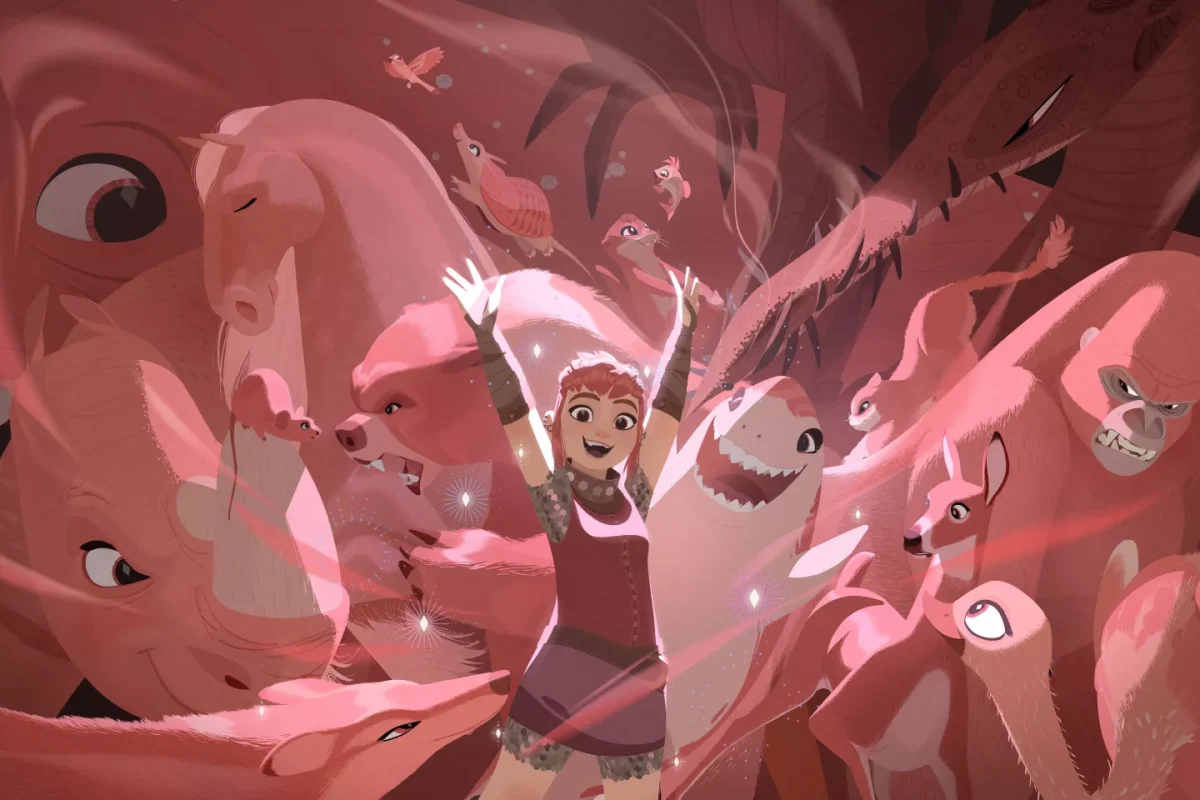
Nimona is a shapeshifter who usually takes the form of a teenage girl, though she also appears as a shark, a whale, a rhinoceros, a bear, and a boy. She is widely regarded in the kingdom where she lives as a monster, though she rejects that label, and all other labels, saying ‘I am Nimona,’ every time she is asked ‘what she is.’ She fits in perfectly with the thesis about the monster being a ‘harbinger of a category crisis’, with it being impossible to define ‘what’ she is.
Also Read: Nimona Soundtrack: Every Song Featured in the Netflix Movie
Nimona is also shown to ‘escape’, fulfilling yet another thesis statement. No matter how many times King Arthur killed the Ogre of Saint Michael, the monster reappeared in another heroic chronicle, bequeathing the Middle Ages an abundance of morte’d Arthurs. Regardless of how many times Sigourney Weaver’s beleaguered Ripley utterly destroys the ambiguous alien that stalks her, its monstrous progeny return, ready to stalk again in another bigger-than-ever sequel, Cohen wrote. Towards the end of the movie, Nimona ends up ostensibly being killed by the weapon targeting the kingdom, in an act of heroic self-sacrifice.
Shortly after that, we see Ballister and other characters mourn Nimona; however, after that, Nimona turns up once again on Ballister’s doorstep. We do not see how exactly she managed to survive. However, with her being a shapeshifter with supernatural abilities, it is not hard to imagine that she found a way to do so.
Monsters are also said to ‘dwell at the gate of difference’, with them often being seen as the ‘other’, in terms of race, gender, sexuality, culture, politics, or socio-economic status. Cohen gives various examples for this–from depictions of Native Americans as ‘savages’ to further a colonial agenda, to myths and stories, like that of Scylla, the Gorgon, Lilith, and Bertha Mason from Jane Eyre, who can be considered ‘women who overstep the boundaries’, only to be seen as monstrous.
Differences in gender identity and sexuality are another example of such differences. For this, Cohen gives the example of how a medieval encyclopaedist describes a ‘hermaphroditic cynocephalus’–a being with the head of a dog, and both male and female organs. Its male reproductive organ is said to be disproportionately large, but the monster could use either sex at its own discretion. Bruno Roy writes of this fantastic hybrid: “What warning did he come to deliver to the king? He came to bear witness to sexual norms…. He embodied the punishment earned by those who violate sexual taboos.”
“Nimona” takes a similar approach, albeit in a subversive manner, with the ‘other’ being the protagonist whom we’re supposed to sympathize with. The movie has widely resonated with the LGBTQ+ community, for its themes, with many widely seeing Nimona’s shapeshifting as a trans allegory. Many transgender and gender-nonconforming people have found scenes such as Nimona saying she feels worse when she doesn’t shapeshift, and her distress at being told to “just be a girl,” particularly resonant.
While Nimona’s character deals with LGBTQ+ themes through allegory, they are handled more directly with Ballister, who is in a relationship with a male fellow knight, Ambrosius. This does not necessarily make Ballister seen as the ‘other’ in the kingdom, as we don’t really see any evidence of homophobia there. However, we do see Ballister being treated as the ‘other’ for a different reason, for his social class. Ballister is the first person not coming from nobility to gain the opportunity to join the knighthood, and he is resented for it.
Monsters are also said to ‘police the boundaries of the possible.’ The monster prevents mobility (intellectual, geographic, or sexual), delimiting social spaces through which private bodies may move, Cohen says. In “Nimona,” this is seen in a literal sense, with the kingdom being enclosed by a wall, and people being discouraged from going beyond the wall out of fear of monster attacks.
The sixth thesis says that fear of the monster is really a kind of desire. The monster also attracts, the essay says. Monstrous characters are often linked to desires of various types, often providing escapist fantasies. The linking of monstrosity with the forbidden makes the monster all the more appealing as a temporary egress from constraint, Cohen says at one point.
Through the body of the monster, fantasies of aggression, domination, and inversion are allowed safe expression in a clearly delimited and permanently liminal space, he adds. Nimona enters Ballister’s life, swooping in with talk of murder and wanting to be a villain. While we find out that Nimona is not really a villain, her proclivities and punk attitude allow a sense of release from constraints.
Unlike “Nimona,” where we are expected to sympathize with the ‘monster,’ the demons of “Kpop Demon Hunters” are, for the most part, unambiguously villainous. However, there are two notable exceptions. Rumi is a demon hunter. She’s also half demon and has patterns on her body that mark demons. There’s also Jinu, a demon who was once human. While Jinu is shown to be an antagonistic character, his story also has nuances and complexities to it, and his connection with Rumi shows that he’s more than a monster.
Find Out: Kpop Demon Hunters (2025) Movie Ending Explained: How is Gwi-Ma Defeated?
Like with “Nimona,” the monstrous figure of the demon in “K-pop Demon Hunters” is the harbinger of category crisis. Most demons look quite distinct from humans, yet we see them take a human form in the scene on the plane at the beginning of the movie, and they’re able to mimic human mannerisms (though shoddily). They are clearly not human, but they have human-like traits. This category-crisis and opposition to the binary is especially stark with Jinu, who used to be a human, and the rest of the Saja boys, who look and act human despite being literal demons. Rumi, too, can be seen as an example of this to an extent.
The idea of monsters that ‘police the boundaries of the possible’ also comes into play. Cohen had noted how the monster often arises to enforce social norms regarding marriage. As a vehicle of prohibition, the monster most often arises to enforce the laws of exogamy, both the incest taboo and the decrees against interracial sexual mingling, Cohen says. He elaborates on several narratives that serve to police interracial mingling–from a Biblical passage that talks about “sons of God” who impregnate the “daughters of men” with a race of wicked giants (Genesis 6:4)–to Shakespeare’s Caliban, who is the “freckled whelp” of the Algerian witch Sycorax and the devil.
Rumi, in “Kpop Demon Hunters,” is a product of such a relationship, with a human mother (who’s a demon hunter, no less) and a demon father. This is a pairing that, according to the rules of its world, should never have been. ‘I am a mistake,’ Rumi says at one point. However, the movie ultimately subverts the narrative, both through Rumi’s relationship with Jinu and with Rumi accepting herself for who she is while continuing to be a heroic demon hunter.
The sixth thesis, which links monsters to desire, can also be seen in “K-pop Demon Hunters.” In Cohen’s essay, he talks about the monastically manufactured Queste del Saint Graal, where Sir Bors encounters a castle where demons disguised as beautiful women try to seduce him. Sir Bors manages to resist temptation and banishes the demons to hell. In “K-pop Demon Hunters,” the Saja boys are shown to be alluring and seductive, with the Huntrix girls being attracted to them right from the start. The movie shows Zoey and Mira having to fight their attraction, to take them down and banish them from the human realm.
Cohen’s final thesis is that the monster stands at the threshold of becoming. These monsters ask us how we perceive the world and how we have misrepresented what we attempted to place. They ask us to reevaluate our cultural assumptions about race, gender, sexuality, our perception of difference, and our tolerance towards its expression. They ask why they have created them.
This can be seen in-universe with both “Nimona” and “Kpop Demon Hunters.” Nimona enables Ballister, as well as the other people in the kingdom, to re-evaluate their beliefs and ideas about ‘monsters.’ They show that so-called monsters aren’t inherently malicious and that they have been unfairly ostracized for their differences. While the demons of “K-pop Demon Hunters” are shown to be more villainous, that movie also questions the assumptions the characters have about them.
The Huntrix girls go from writing songs like ‘Takedown’, which talk about how the demons make ‘hatred grow out of their veins’, and how a demon with no feelings ‘don’t deserve to live’, to songs like ‘This is What it Sounds like’, which focuses on self-acceptance. Rumi’s parentage and her relationship with Jinu suggest that there is more nuance to demons than they previously believed.
At the same time, the way the ‘demon boy band’ fosters unhealthy parasocial relationships with their fans also brings up real-world issues related to celebrities and fan culture. The ‘monsters’ in both these movies make people think about the world, both in-universe and with real-life audiences.