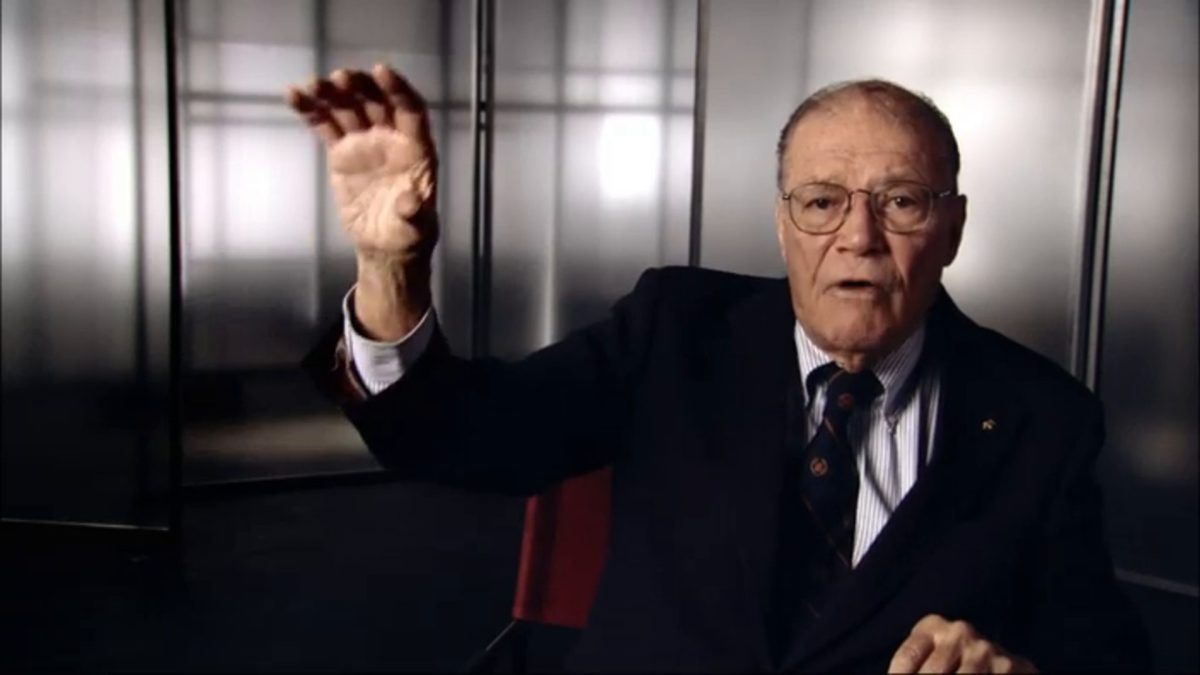
Bob Mcnamara: Now I remember exactly the sentence I left on. I remember how it started, and I was cut off in the middle. But you can fix it up in some way. I don’t want to go back and introduce the sentence, because I know exactly what I wanted to say.
Errol Morris: Go Ahead!
Bob Mcnamara: Okay. Any military commander who is honest with himself, or with those he’s speaking to, will admit that he has made mistakes in the application of military power…At my age, 85, I’m at an age where I can look back and derive some conclusions about my actions. My rule has been try to learn, try to understand what happened. Develop the lessons and pass them on.
Who starts a documentary like that?! Errol Morris’s “The Fog of War” (2003) opens not with a sweeping montage or authoritative narration, but with an the older Robert S. McNamara, the brilliant but morally obtuse defense secretary who ran the Pentagon throughout most of the Vietnam War, stumbling back into his own unfinished thoughts. But Phillip Glass’s score, which starts moments earlier as a prelude to the film, would have you thinking you’re right in the middle of the action. The moment encapsulates both Morris’s creative choices and McNamara’s character: a man eager to control his narrative, yet still vulnerable to interruption and incompleteness.
The film is framed around eleven “lessons,” drawn from McNamara’s career as one of America’s longest-serving and most consequential Secretaries of Defense. But what lingers in the mind of the viewer is not the quality or depth of the lessons but the portrait of a flawed man, deeply intelligent, calculating, but unable to fully comprehend the scale and impact of the power he once wielded and the decisions he made.
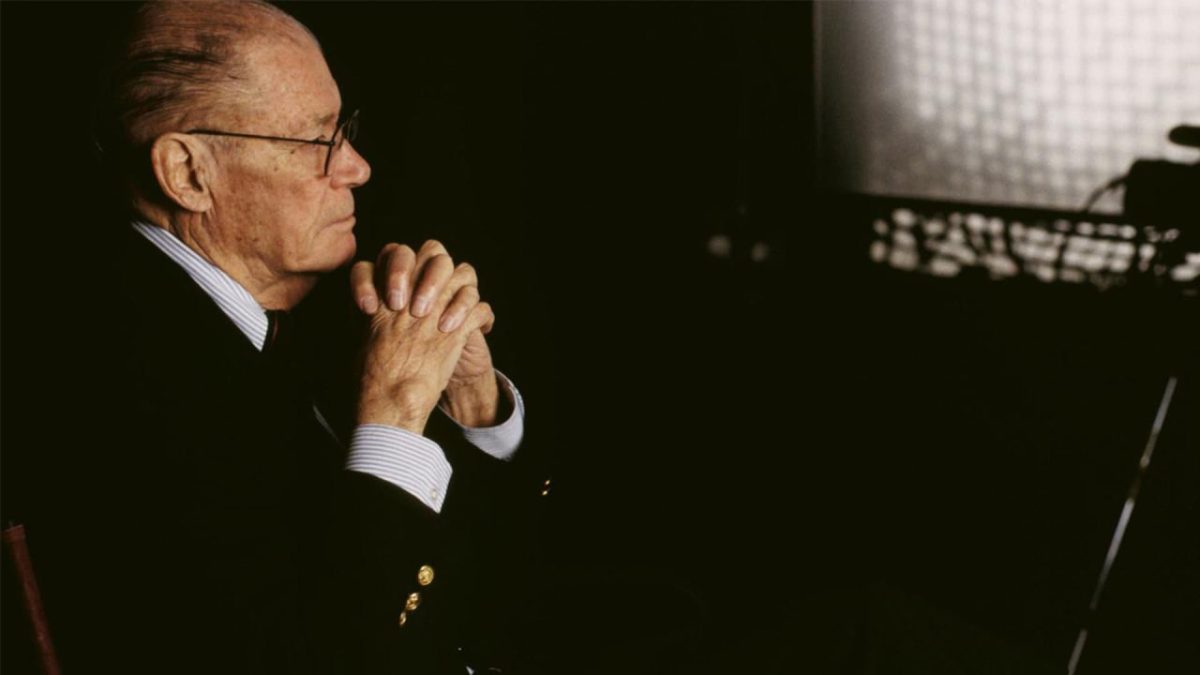
McNamara touches on some of America’s most prominent historical moments from his own purview. The Cuban Missile Crisis, which he deems “thirteen days that shook the world,” is illuminated by his telling of the two conflicting transcripts that the government received from the leaders of the Soviet Union and how close the world came to nuclear war.
And when he speaks about Kennedy, his loyalty to the man and his sorrow over Kennedy’s ultimate demise are palpable, and pop off the screen. This, of course, contrasts mightily with Morris’s depiction of McNamara regurgitating casualty statistics like a calculator, a passage which Morris overlays with an animated sequence where numbers fall from the sky like bombs themselves, destroying villages and cities.
The meat of the film is the Vietnam War, and the way that the war unfolded under McNamara’s guidance. The former SOD sees a few consequential events that made the war a disaster for America. He believes that Kennedy wouldn’t have sent troops after the Gulf of Tonkin. And of course, without the Gulf of Tonkin, he claims that the Vietnam War wouldn’t have been the disaster it was, a tragic divergence in the course of the country’s history.
Three images from the film remain in the mind long after the credits have run. McNamara speaks to each of them. He recalls the Buddhist monk who burned himself to death in Saigon in 1963, an image so stark and disturbing, and one that highlighted how little American intelligence knew or understood of Vietnam’s own history and internal conflict.
Two years later, another man burns himself to death: this is an American protesting the war, and he does it outside the Pentagon, beneath McNamara’s office, a haunting image that Morris allows to linger in the film. It helps us to see one “lesson,” which is how often war is conducted with numbers and in the abstract, while it is lived by real people living real lives. Morris shows it like a scene from “Rear Window,” with McNamara crunching statistics in one window pane, while on the floor below him, Keith Morrison, the 31-year-old Quaker protester, burns below him.
The third image occurs in a moment of reflection. McNamara describes meeting Nguyen Co Thach, the former foreign minister of Vietnam, during a 1995 conference in Hanoi marking the 20th anniversary of the end of the war, and the two end up in an argument, locking heads in an image captured from behind, their heads in perfect symmetry, their eyes bursting with intensity. The meeting illuminated the decades of misunderstanding and miscommunication that had characterized the war.
Schooled by Thach, McNamara confronts the Vietnamese determination that they were not pawns of the Chinese or the Russians, but a people who wanted only one thing: independence. Schooled by McNamara, Thach confronts the fact that the U.S. never intended for Vietnam to become a colonial subject, only that the Russians and Chinese not extend their influence throughout Southeast Asia. Yet how many lives were destroyed while the combatants fought two different wars?
“The Fog of War” earns its place in film lore because it tackles the contradiction that was the rising power of America’s Defense Department, and the moral dilemma of a country left with the guilt of its own actions. “We were wrong, terribly wrong,” McNamara admits, while insisting on the need to pass his lessons forward. Oddly, he justifies the war as a necessary passage. His voice trembles as he declares that “in order to do good, you may have to engage in evil,” a thought as unsettling as it is enduring.
McNamara concludes that the phrase, “‘the fog of war’” means that war is so complex it’s beyond the ability of the human mind to comprehend all the variables. Our judgment and our understanding are not adequate. And we kill people unnecessarily.” A man so driven by tactics, numbers, and strategy, missed the humanity and motivations of the other side, highlighting the need to “empathize with your enemy. “ He briefly remarks on a line from the poet, T.S. Eliot: “We shall not cease from exploration, and the end of all our exploring will be to arrive where we started and know the place for the first time.”





![Inside Llewyn Davis [2013] Review: Wings of folk singer’s desire](https://www.highonfilms.com/wp-content/uploads/2017/08/insidellewyndavis-012.jpg)