
Propaganda is important – socially and politically. Hence, we kept a close eye on the “Mardaani” franchise since its first instalment came out in 2014 (directed by Pradeep Sarkar), as it offered a space to scrutinize women’s position in the power matrix. This trend has been followed by, though in different genres, the “Stree” franchise, “Sherni” (2021), and the likes of “Soni” (2018), which alone, among the mentioned films, had the opportunity to go global in terms of partaking in international festivals and screenings.
However, the advantage with the “Mardaani” franchise has been twofold: it has operated thoroughly in the out-and-out mainstream discourse – having the virtue of directly engaging with audiences, without any opacity, coming from different strata – and it has never re-appointed the same director, thus incorporating three different points of view of three different male directors till date about how they would like to see a woman cop functioning in a social fabric woven hand-in-hand by misogyny and patriarchy.
Coming to the question of whether “Mardaani 3” is a good film or a bad one later, what bothered me most about this latest installment is the franchise’s lack of interest in veering the series towards a radical path. I could still refrain from arguing what stopped the production from appointing a woman filmmaker to direct at least a single film, fearing that the liberals might find the question pathetically ridiculous and out of context, but what I couldn’t stop myself from asking is: What about the politics, man? A series dealing with misogyny should have the courage to orchestrate a trial – of course, a fictional one – of those responsible for repressing women and regarding them as inferior creatures. Who are they if not the men in power?

Also Read: From A-Listers to Crew Women, How Hindi Film Industry’s Feminism Rings Hollow Without Basic Dignity
What pains me is the fact that the problem has been pointed out in the previous two films, and instead of prioritising the task of re-locating the female agency, “Mardaani 3” has ended up navigating in the same area of entertainment. When you’ve undertaken a task to deal with a vulnerable subject, it is also your task to invent or reinvent a discourse through which you could channelize your commentary. In spite of that, the film retains certain tropes that are often used to highlight masculinity; for example, the film begins with a certain kind of sequence that you have already seen in “Jawaan” (2023).
I mean, the tropes are identical. However, Bollywood has never cared for praxis. Theoretical concerns keep running on a different plane than what the industry comes up with every time, and projects that could have reinvigorated a certain agency or genre are often pushed towards the bog water of age-old conventions. That’s what happened with “Mardaani 3.” The entry sequence of the protagonist is a mere repetition of an idea that has previously become super successful, indicating the maker’s primary inclination towards business. What is my coda to this section is: Interchanging Rani Mukerji with Shah Rukh Khan is a regressive attempt to keep the male-dominated status quo intact.
This criticism, strictly based on ideological grounds, has an apparently loose connection with the spectacle that unfolds with the film as the lights go off inside the theatre. “Mardaani 3” is Abhiraj Minawala’s return to a directorial job after “Loveyatri” (2018), which didn’t do well both commercially and critically. Written by Ayush Gupta (who is also the writer of “The Railway Men – The Untold Story of Bhopal 1984”), the film is mostly a catch-me-if-you-can thriller that begins in India and ends in Sri Lanka.
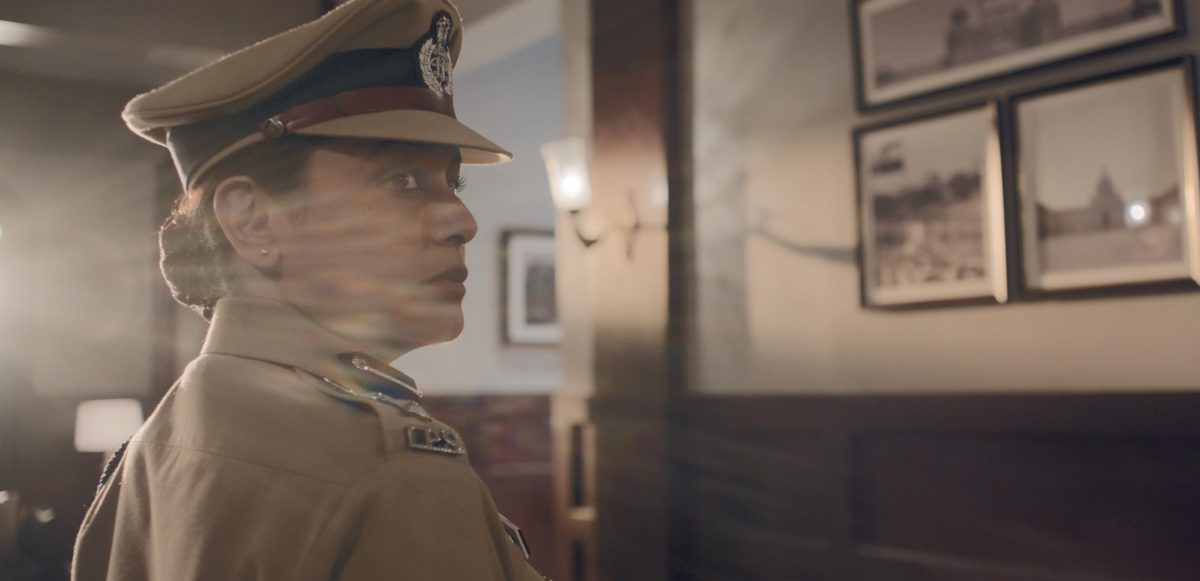
It all began with the abduction of a high-profile Indian diplomat’s daughter, and the authorities demanded the appointment of Shivani Shivaji Roy (Rani Mukerji) to investigate the case. Rani vigorously re-enacts the character, and this time she employs a little bit more Sherlock-like brainstorming to demystify certain things that intermittently blur the line between real and magical. Beginning the mission with what looked like a simple case of child abduction, Roy soon discovers the entire nexus of the beggar mafia and the covert project of a certain pharmaceutical drug in Sri Lanka, where abducted children are smuggled.
What I liked about the film is the compact screenplay that didn’t have a single dull moment, especially in the first half, and runs with a pace that doesn’t falter. We didn’t have to wait long to witness the face-off between Shivani and the kingpins behind the beggar-mafia nexus – brilliantly played by Mallika Prasad and Prajesh Kashyap.
Mallika Prasad’s character – “Amma” – had the potential to scare the fainthearted with her one gaze in a dark setting, and Prajesh Kashyap’s rendering from an innocent charity man to a cold-blooded, compulsive criminal (“Ramanujan”) is praiseworthy and makes them potent antagonist in front of a protagonist notorious for being morally upright amid the underbelly run by criminals.
Related: Mardaani 2 (2019) Movie Review: Not Layered Enough
The film ceased to work for me during the latter half, primarily for two reasons: first, as the entertainment slowly faded, the ideological lens strengthened to scrutinize the very idea of the film, and second, the camera operation made everything so predictable. When you linger your camera, more than expected, on the very face of your most ambitiously potential antagonist, what does that mean? When on the voyage of making a thriller, the last thing one can do is make their antagonists predictable.
Anyway, there’s no reason to refrain from calling a spade a spade. “Mardaani 3” is entertaining – not always intelligently, though. The tight screenplay almost keeps dull moments away, and a special thanks to the makers for attempting to normalize a film navigating in the mainstream discourse without a single song – apart from a chorus-like ‘Aigiri Nandini’ that works as a narrative on a different plane beyond the visual and helps to embody the Durga myth, which further strengthens Roy’s character. What problematizes the film is its commitment to making an entertaining film, outplaying its commitment to making feminist propaganda without compromising the aesthetics.
P.S: On a light note, making male characters unrealistically fragile (like Shivani’s husband played by Jisshu Sengupta) doesn’t make a feminist film feminist, and I have never seen a villain explicitly declaring in front of the protagonist: “I’m a Capitalist!” – That was real fun stuff, and thanks to the maker for that!






![Violence Voyager [2018]: Fantasia Film Festival Review](https://www.highonfilms.com/wp-content/uploads/2018/07/Violence-Voyager-2018-768x432.jpg)