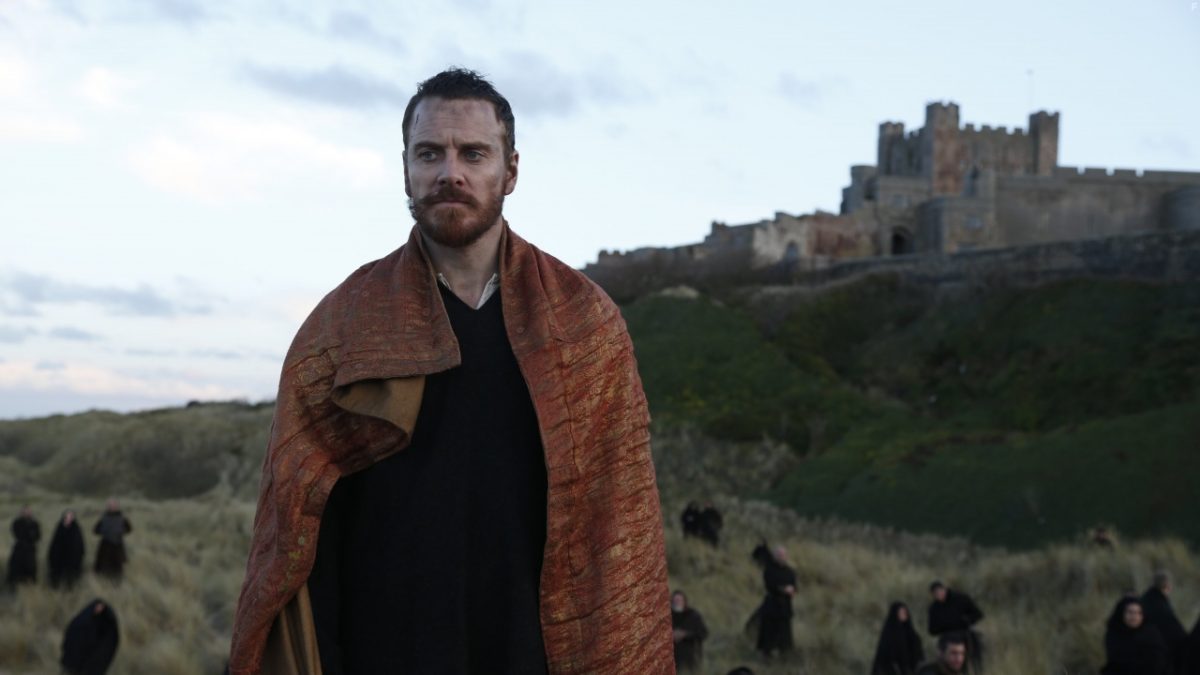
There is a moment in 2015’s “Macbeth” from director Justin Kurzel, and it’s not the murder or the banquet, not the witches hovering like smoke over a battlefield filled with the properly dead, where Michael Fassbender looks at nothing. That’s all, just looks. Eyes open and focused on something that’s about three feet past the known universe. He’s standing in a hall that feels like the inside of a skull. And it’s then that we understand with the clarity only great cinema or bad whiskey can provide, that this man isn’t afraid of what he’s going to do. He’s already gone.
That’s the thing Kurzel understood and something a lot of people adapting Shakespeare miss because they’re too busy being reverential. “Macbeth” isn’t a cautionary tale about ambition, or a morality play about what happens when you want too much. They are the tourist versions of the story, the reading you get from someone who’s never wanted something badly enough to make themselves sick.
The real story, which Kurzel is telling with a camera that moves as though it’s trying not to wake someone sleeping, is about what happens after ambition. What’s left in that space where ambition used to live. If you were wondering, the answer is nothing. And it turns out that nothing is the most frightening ingredient in the whole blood-soaked recipe.
Let’s back up a moment, to the movie’s opening scenes, as Kurzel doesn’t waste them. He doesn’t open in a throne room, or lingering shot of a castle, or any of the standard heraldic scenery that lets us know we’re in for four-quadrant prestige. No, he opens on a funeral. A child’s funeral. Macbeth and Lady Macbeth are burying what seems to be their young son.
This isn’t in Shakespeare’s text; he was purposely evasive about whether the Macbeths ever had children or what happened to them. Kurzel invents this grief, inserting it into the beginning of the story like a knife between the ribs, twisting slowly. It’s not an accident. It’s the entire interpretive argument of the movie, plainly stated, before a single word is spoken.
They are people who have already lost the thing they wanted most. All that follows, the witches, the prophecies, the king murdered in his sleep, and the crown that sits on their heads like a migraine, it’s all happening to people who are already, in the deepest sense, bereaved. That ambition, which Shakespeare’s text treats like something that corrupts Macbeth from the outside, the occult suggestions of the witches, the will of Lady Macbeth applied like a blade to a whetstone, is reframed by Kurzel as something that was always there. Hollowed out, the space where a future used to be.
Michael Fassbender’s Macbeth isn’t a man climbing, he’s falling and mistaking that acceleration for flight. And that brings us to the battlefield, and what Kurzel does with it. The opening battle scene, rendered in desaturated slow-motion with bodies moving through the fog like swimmers and blood flying in geometrically thoughtful arcs, isn’t staged for excitement.
Other directors have tried that same terrain and came out with “Braveheart.” Kurzel films something that feels less like war and more like a dissociative episode. The violence is real in that it registers as a cost. But there’s no catharsis in it. Men die, and it means something in the same way that things happen for no real reason mean something: heavily and with no resolution.
We are watching, but without realising yet, Macbeth’s nervous system is beginning to collapse. He fights brilliantly but mechanically, a man used to functioning inside horror because the alternative is not to function at all. It’s not heroism in the classical sense. We see someone who has already separated himself from the outcomes. He kills as killing is the thing he’s doing at that moment, and that moment is the only temporal zone left open to him.
When they arrive, the witches aren’t a dramatic interruption. They’re almost a non-event; three women and a child standing on a charred hillside, speaking prophecy into the air. And Fassbender takes it like a piece of mail he knew was coming. There’s no shock, and barely any curiosity. There’s just: yeah. King. Right. Got it. This is the interpretive master-stroke of the movie, doing its work quietly, the way the best chefs work. You don’t watch them sweat, you taste it in the food.
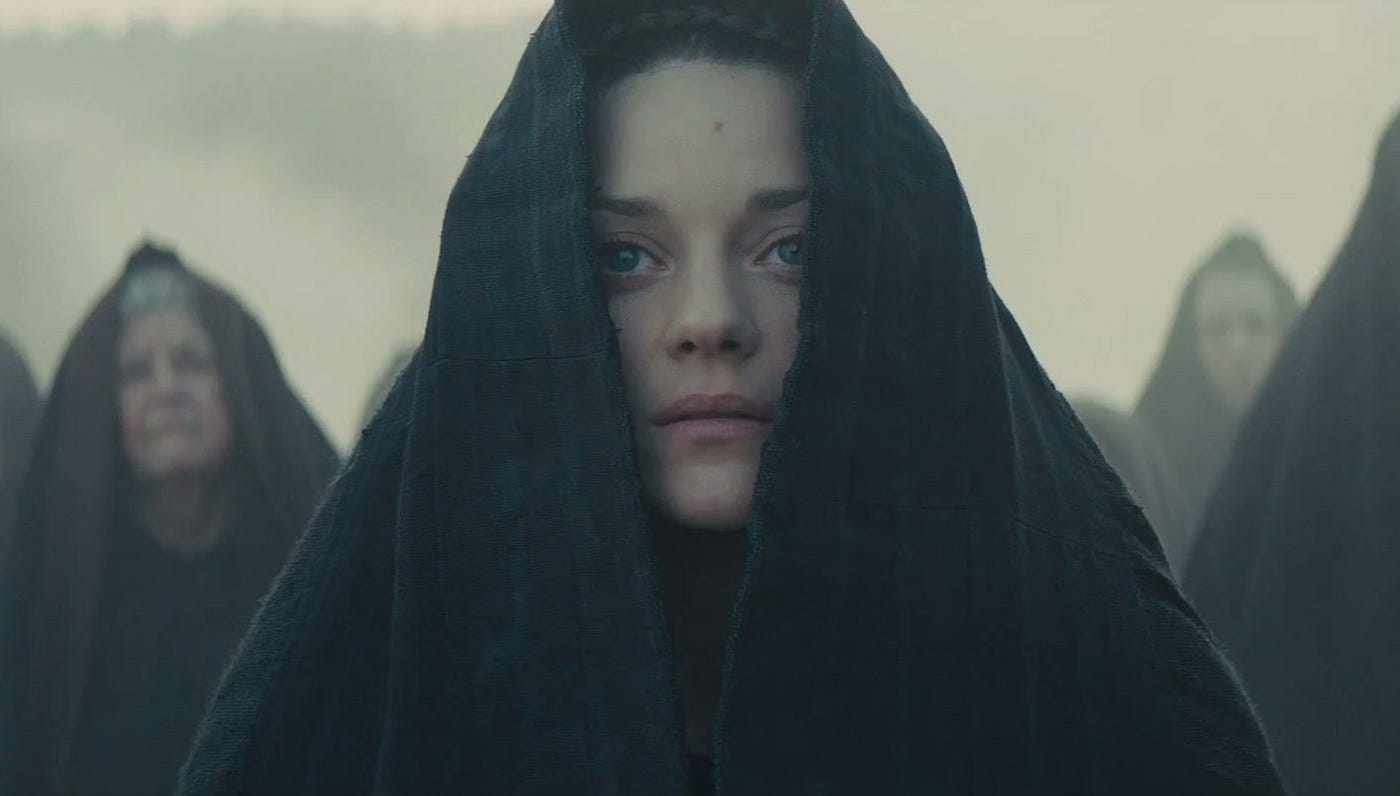
And Marion Cotillard. She is doing something in this movie that doesn’t get enough recognition, and I think it’s maybe because she’s doing it in a Scottish accent that the critics seemed to find distracting. That tells you more about the critics than it does about accents, but I digress. In most productions, Lady Macbeth is a force of nature. She’s the accelerant, the force of will, pouring ambition into her husband’s ear like she’s following a recipe for something devastating. Cotillard plays her differently, as someone who knows the recipe and has made the dish in her mind a thousand times, now standing in the kitchen and wondering if she’s actually hungry.
There’s a version of the “unsex me here” speech that is all righteous fury and dark power. Female rage, weaponised against a world that denied her agency. Cotillard delivers it quietly, almost speaking to herself. A prayer said without faith. It isn’t invoking the spirits, she’s trying to convince herself. We watch it, thinking: she’s been running on compressed energy for years, on some sense of purpose. And now that purpose is within her reach, she’s finding out what people who’ve wanted something their whole lives occasionally find out; the wanting was the point. And getting it is a different country, where she doesn’t speak the language.
This isn’t ambition. This is its shadow, its afterimage. She calls Macbeth “too full of the milk of human kindness,” but she isn’t describing a weakness. She is describing what she’s afraid she’s becoming. The cruelty that comes easily early in the movie becomes an effort towards the middle. We see it happening, the psychic cost building, how extreme acts of will usually devour the person willing them. She loses her mind not because she’s weak, but because she was always more human than she wanted to admit, and what she put herself through in order to become otherwise broke her.
Let’s discuss Duncan’s murder.
Also Read: 8 Crucial Cinematic Adaptations of Shakespeare’s ‘Macbeth’
The ghost of a boy soldier gives Macbeth the dagger he notices early in the movie, which was used in battle. After Macbeth brutally murders the king, he and Lady Macbeth both wash their hands, claiming they have washed the deed away. Then, in an audacious choice, Kurzel gives us a quiet, liturgical moment in a church tent, with Duncan’s body receiving blessings, as Macbeth presides over his crime like a priest at a sacrament he doesn’t believe in anymore. The movie clearly says here that the murder isn’t the dramatic apex. The murder is the transition, and what happens in the aftermath is the real subject.
After Duncan’s murder, Fassbender’s face does an interesting thing. It settles. Before there was tension, the coiled quality of a man waiting to do something, and after the murder, there is a strange calm. Not the calm or relief or satisfaction, but the calm of someone who has crossed a line they always thought they would cross and has now confirmed what they always suspected. The experiment is over and the mystery resolved. And as it turns out, the result isn’t illuminating. It’s just information.
After Banquo is murdered, and the guilt is beginning to show in new and inconvenient ways, Lady Macbeth tells him, “What’s done is done.” She means it practically, telling him to let it go. To move forward. The machinery is in motion, and it doesn’t care about your feelings. But Macbeth hears it differently. He’s taken it as a cosmological statement. “What’s done is done.” Past tense and permanent. And if what’s done is done, then what is the point of anything? Why Fleance? Why Banquo? Why were Lady Macduff and her children burned at the stake?
That scene, perhaps the most brutal in the movie, is a casual slaughter rendered in firelight and long takes. It’s an atrocity you commit not because you feel anything about it, but because you don’t. They aren’t the actions of a man who wants something, but the actions of a man who has decided that, since absolutely nothing matters, then action is its own justification. This is what the movie is really about. Not the moving from innocence to guilt; that’s the high school syllabus. The movie is about the transition from desire to the absence of desire. What it looks like when a person stops having any reasons and has only momentum.
In contemporary discourse, the word ‘numb’ is overused. We apply it to things that are simply tedious and numb ourselves. It sounds more interesting than boring. But there is a real psychological experience that happens when someone absorbs more than their system can handle: when life’s events come too fast and too heavy, and the mind’s self-protective mechanism kicks in and starts shutting down circuits. It isn’t madness or dramatic dissociation. It’s just…distance. The world still registers, but at a remove. You can watch yourself doing things and observe your own behaviour in the same way you’d watch someone else.
It’s this that Kurzel puts on screen, and what Fassbender finds in his body. It’s a particular stillness of a man for whom the connection between intention and consequence has been cut. He makes decisions the same way we make decisions in a dream: because the situation’s logic demands it, not because you actually want something.
In most productions, the banquet scene with Banquo’s ghost is a piece of theatrical hysteria; Macbeth is raving, and Lady Macbeth is trying to manage him and the horrified guests. In Kurzel’s version, something stranger is happening. Banquo’s ghost is real in that Macbeth perceives it as real, but Fassbender plays it as a man resigned instead of terrified. Of course, Banquo is here, and the dead come back. This is how the world is now: the dead sit in your chair, and you try to make dinner-party conversation around them. Fine. This is fine.
The terror has become infrastructure.
The sleepwalking scene with Lady Macbeth is the most devastating sequence in the movie, and Cotillard plays it as a woman returned from a place without a name. She is out of time, trapped at the moment of the murder, the way some trauma survivors get trapped, returning to the event and trying to wash something that can’t be washed. Out, damned spot. That line is famous enough that it’s almost invisible, and when we hear Cotillard say it, it’s as though we’re hearing it for the first time.
She isn’t Lady Macbeth anymore. She’s all that’s left after Lady Macbeth burned herself down from the inside: a remainder, a residue. There’s a certain sadness Cotillard brings here: a woman with incredible capacity and force, and what she applied it to consumed her. It’s the saddest waste when talent is directed to the wrong thing.
Macbeth receives the news of her death; she should have died hereafter, with famous detachment—tomorrow, and tomorrow, and tomorrow. The speech isn’t played as grief or even nihilism in a dramatic fashion. But something more mundane and more chilling, just a simple accounting. Macbeth is just a man doing the math. Time is stretched out with no meaning. Events build.
Nothing adds up to anything. She would have died eventually. Everything dies. Signifying nothing.
Also Related: The 25 Best Films of 2015
Fassbender speaks these words like he’s delivering the weather. A man who has arrived at this philosophical position not through intellect, but through experience. He has lived his way into nihilism and has done and lost enough to have the certainty which comes with evidence.
The final battle of the movie, again rendered in saturated slow motion, darkness, and fire, with Malcolm’s soldiers carrying the branches from Birnam Wood through a burning apocalypse, is not triumphant. Nothing in this movie is. Macbeth walks into battle the same way he walks into everything in the second half: with a focused indifference of someone who has decided that the point of going through the motions is that at least this way the motions get done.
He dies fighting, and it’s the only honest thing left to him. Not because he believes in the fight, or thinks he can win. The witches’ prophecies have come undone with the particular cruelty of prophecy; they are technically accurate and utterly useless. He fights instead because he is a man who has only ever known how to do one thing well, and even if he does it badly in the end, it is still doing it. It’s almost Zen, if Zen had much more blood and a lot less karmic debt.
Macduff kills him, and Malcolm is crowned. The world resets, and the machinery of kingship, the great grinding wheel, makes another rotation. Somebody else will be the next Macbeth. Somebody else will be standing in a blood-drenched field after a battle and hear what sounds like an offer. The movie leaves a question hanging: whether that wheel can ever be escaped, or whether some people, after experiencing a certain kind of loss, will only run toward the thing that will finish them.
In its popular form, ambition is understood as the pursuit of acquisition. You want something, and you either get it or you don’t. But either way, that wanting is the driving principle, which makes the alarm clock worth answering. Kurzel’s version of “Macbeth” proposes something darker: that in extremis, ambition can reverse itself. That with enough loss and violence, with enough transgression against your own sense of what’s permissible, can hollow out the wanting. And can change the drive to acquire into the drive to conclude simply. To get to the part where it’s finally over.
What’s done is done. And in this reading, Macbeth is not a man destroyed by his ambition. Instead, he’s a man who used ambition as the method for his own destruction. He found in the witches’ prophecies not opportunity but permission. The permission to stop holding himself together and become the thing he was always afraid he was, and prove that suspicion correct. The tragedy isn’t that he wanted too much; it’s that somewhere along the way, he stopped wanting anything at all but kept moving, as that’s the only thing he knew how to do. In the absence of meaning, momentum is its own justification.
Kurzel’s movie isn’t easy to watch or enjoyable in the traditional sense. It’s the experience of watching someone disappear in real time. Actually, two people are disappearing in parallel, at different speeds and through different mechanisms, but they are headed toward the same destination. It’s beautifully shot, paced like a fever dream, and performed with a commitment we rarely see these days. It’s the kind that makes the actors go somewhere and trust the cameras will catch them there.
But more than any of that, more than the considerable craft, the movie is true in the way the best adaptations of the classics are true. It finds that current of meaning which runs under the text and follows it somewhere Shakespeare couldn’t quite follow. Not because he lacked the vision, but because the form, the stage, and time required other things. Kurzel had a camera, fog, the Scottish Highlands, and Michael Fassbender’s face. He used all of them in the service of a single, uncomfortable argument.
That the most dangerous state a person can be in isn’t hunger. It isn’t desire or ambition.
It’s the moment after all that. The morning after you have stopped caring about the thing you built your life around caring about. But the world is still there. You’re still there. The day still needs that you do something with yourself.
What’s done is done.
What comes next is the part nobody talks about.