“If “Psycho” had been intended as a serious picture, it would have been shown as a clinical case with no mystery or suspense. The material would have been used as the documentation of a case history. We’ve already mentioned that total plausibility and authenticity merely add up to a documentary. In the mystery and suspense genre, a tongue-in-cheek approach is indispensable.”
In a conversation with Truffaut, Hitchcock says the above words. In the 1960 film “Psycho,” we have the case study of a mind divided into two dangerous halves– one of the self/son-lover, one of the dead mother.
Psycho (1960) Plot Summary & Movie Synopsis:
Hitchcock’s “Psycho” opens with two lovers, Marion Crane (Janet Leigh) and Sam Loomis (John Gavin), lazing on their bed and making love. When Sam expresses his concern over his enormous debt making him unable to take on the responsibility of a marriage, Marion does the needful. She siphons off $40,000 in cash from her sleazy employer. Immediately, she sets off for Sam’s house in Fairvale. However, after a suspicious policeman tails her car and questions her abruptly, she is forced to change her car. A heavy rainstorm causes yet another impediment, and she is forced to take shelter at the sequestered Bates Motel.
The young proprietor, Norman Bates (Anthony Perkins), shows interest in her and asks to accompany him for a very humble dinner of sandwiches and milk. What’s interesting is the Bates manor, an imposing, gothic structure, that overlooks the comparatively diminutive motel. As Marion begins to unpack her luggage and scrambles for a safe place to hide the wad of cash, she overhears a screeching female voice in conversation with Norman.
The woman disapproves of Norman’s decision to bring Marion into the house. She accuses him of having a cheap, erotic mind. By now, it is clear that this is Norman’s overbearing mother. She fears that Marion is here to steal her sin from her. She threatens that if Norman does not do the needful to throw her out of the motel, the mother will do it for him.
When Norman returns, he realises that Marion has overheard the conversation. He invites her to the parlour to have supper. Marion notices that the parlour is adorned with stuffed birds. This allows Norman to speak extensively on his rather eccentric hobby of taxidermy. Norman, being too attached to her mother, is visibly disturbed to hear Marion’s suggestion of sending his mother to the madhouse.
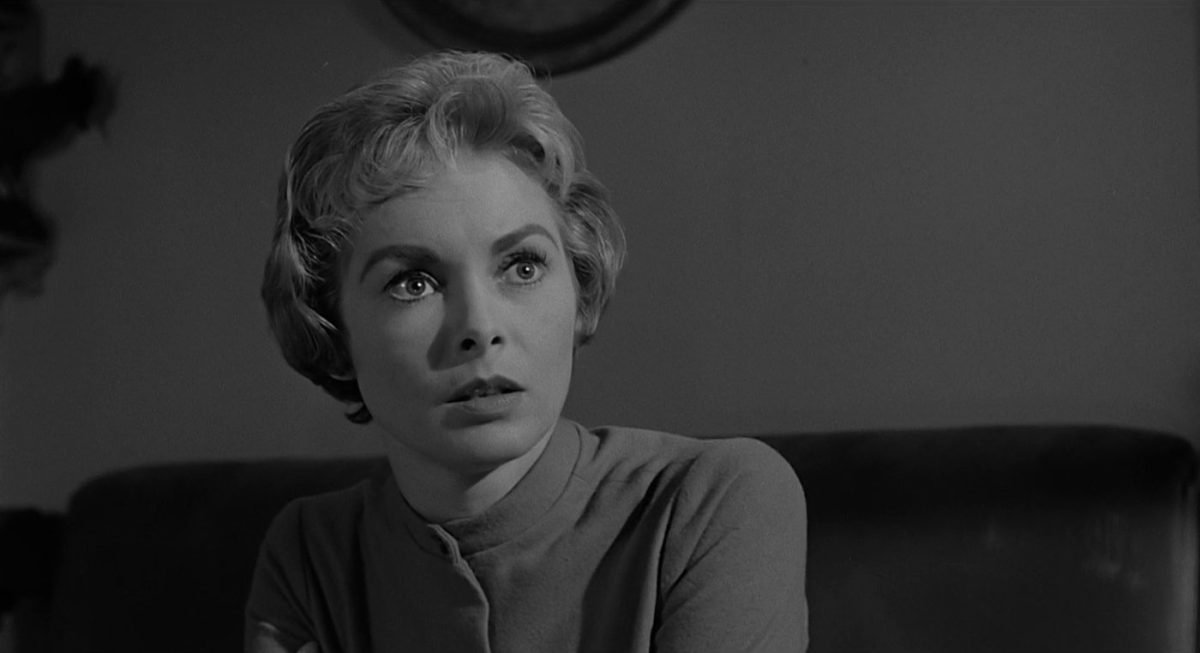
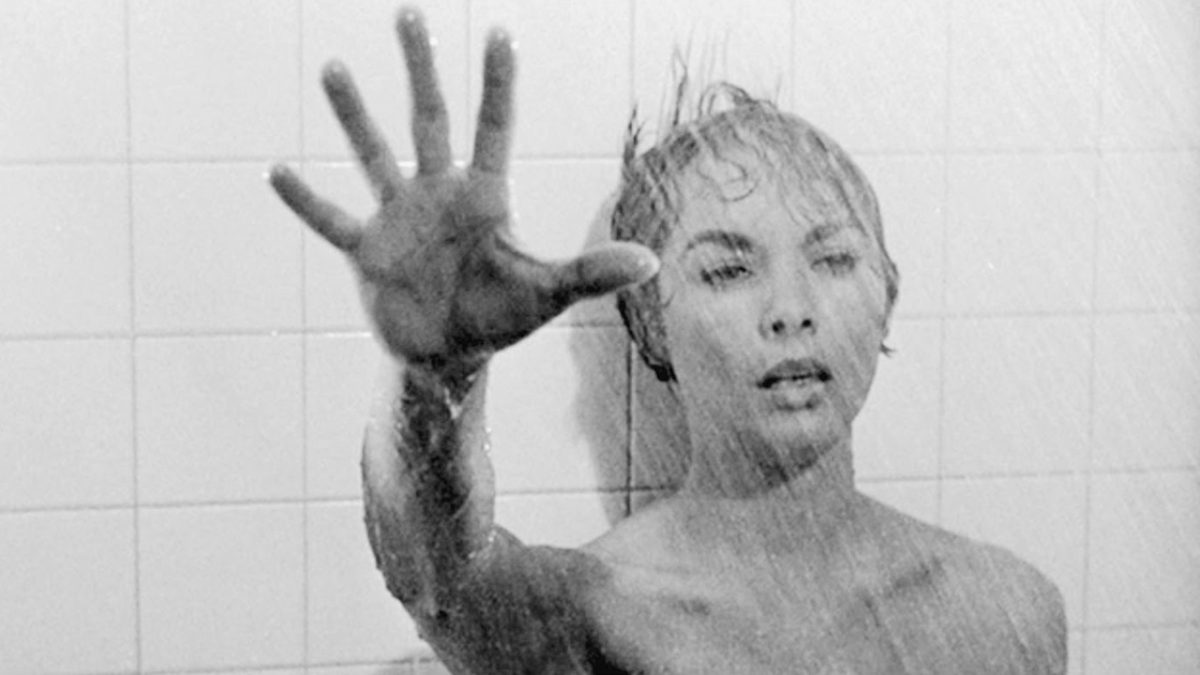
As Marion retires for the day, Norman plays a peeping-tom unbeknownst to her. Marion has a change of mind and decides to return to Phoenix to put the money back in its rightful place. As she takes a shower, a silhouette appears on the shower curtain. The woman, presumably Norman’s mother, stabs Marion with a kitchen knife. Norman tries to clear up the crime scene by making the body of Marion and all her belongings, along with the cash in the car, sink in the swamp.
Marion’s sister, Lila (Vera Miles), arrives at Fairvale in search of Sam, presuming that he might know about her sister’s whereabouts. Sam is equally puzzled to learn that his lover has been missing. A private investigator, named Arbogast (Martin Balsam), eavesdrops on their conversation and joins them, stating that he, too, is, in fact, in hot pursuit of Marion, who he believes has stolen $40,000. Arbogast arrives at the Bates Motel and proceeds to question Norman. Norman fumbles throughout the interrogation, which causes Arbogast to straighten up and take notes.
As Arbogast scrutinises the guest register, he finds the alias name of Marie Samuels that Marion uses to be in disguise. Norman tries to shoo him away by playing a game of pretense. Arbogast insists that talking to the mother would help the investigation. While trying to keep him away from his mother, Norman casually slips out that Marion had met his mother. This causes Arbogast to become irresolute on his plan to meet Mrs. Bates. He leaves to intimate to Lila that Marion was in fact at the Bates Motel. He returns and enters the empty manor in search of the old woman. As he ascends the stairs, the woman stabs him and causes him to fall from the stairs, and continues the violent and vehement stabbing till he is dead.
Psycho (1960) Movie Ending Explained:
Is Norman’s mother dead?
The local sheriff, Al Chambers (John McIntire), tells Sam and Lila that Norman’s mother had been dead for the longest time. It was a semi-murder through poisoning. Sam and Lila, having seen the silhouette of the mother at the mansion, try their best to make Chambers believe that what they saw was real. Chambers, on the other hand, maintains his stance that it might have been only an illusion.
Worrying that Arbogast might have fallen prey to the mother-son duo, the two drive to the motel. They meet Norman, and Sam tries to distract him as Lila enters the house. In the fruit cellar, Lila is forced to face the bugbear– that Norman’s mother’s remains have been mummified, and it is Norman who is keeping his mother alive and is on a killing spree by dressing up as the lady.
At the police station, the criminal psychologist explains that the identity of Norman Bates has completely dissolved and become innate with that of the mother. It was the mother half that killed Marion. Ten years earlier, when a lover entered his otherwise overbearing mother’s life, Norman became distraught and killed them both. Unable to bear the trauma of committing matricide, Norman tries to obliterate the event by absorbing the mother’s identity. Norman keeps the mother’s corpse but breathes life into her by assuming his identity– thereby, speaking on behalf of her.
He knows that the mother feels jealous of the women he feels aroused by; therefore, assassinating Marion came only naturally to him as he acted in accordance with the mother’s desire. Earlier, the psychologist explains, he only dressed up as the mother and pretended to be her. Now, he is the mother.
The film ends with Norman sitting in the interrogation room, cold and alone, battling with the mother’s voice in his head. The mother tries to rationalize the crime and says it’s all her son’s doing. In the end, she maintains that she is harmless and would not even hurt a fly, as the dissolve shot of the skeletal remains of the mother bleeds into the face of a smiling Norman.
Psycho (1960) Movie Themes Analyzed:
A son is a poor substitute for a lover
As Marion enters the parlour to have supper with Norman Bates, the sight of the walls with stuffed birds piques her curiosity. Norman constantly talks about birds and opens up about his unusual hobby of taxidermy. The conversation naturally veers towards Norman’s mother when Marion asks him about his friends. Norman unflinchingly states that a boy’s best friend is his mother. Norman begins to talk about his childhood with his mother and his father. When he was five, his father died, and a few years later, when she met another man, he died too. All she had left was her son. It does not take long for him to understand that his mother is trying to use him as a substitute for her long-dead lovers. Therefore, the mother feels jealous every time the son tries to get too close to any other woman.
In his Oedipus Rex, Freud writes, “It is the fate of all of us, perhaps, to direct our first sexual impulse towards our mother and our first hatred and our first murderous wish against our father.” Hitchcock, it seems, intuitively amalgamates this concept in his film through Norman Bates. In the Hitchcock biography, Patrick McGilligan notes that the director first browsed through the writings of Hitchcock in the 1920s.
In Norman, one can notice a murderous urge directed towards both the lovers of his mother. However, the mother, no matter how violent, is portrayed as harmless, like that of a child who is to be taken care of. The acceptance of the role of the lover and the caretaker causes him to forcefully comply with a private trapping from which there is no escape.
Taxidermy or breathing life into the dead
“Freud’s focus on sex and death is more concrete, memorable, and saucy.”
– Constantine Sandis
Norman’s eccentric hobby of stuffing birds produces what is perhaps a very threatening visual imagery that portends what is to be revealed in the end. Norman ‘fills’ his ‘empty’ time by practicing taxidermy, mirroring the act of filling the bird corpses with cotton wool. While talking about the corporeal Gothic in Psycho in her book, Subarna Mandal talked about the three vandalised bodies that populate the narrative and aesthetic of “Psycho.”
They are the ‘decaying body of Mrs Bates, the deranged body of Norman Bates, and the tortured body of Marion Cranedecaying body of Mrs Bates, the deranged body of Norman Bates, and the tortured body of Marion Crane.’ In a way, the acquiescent bodies of the three become sites of dissection and restoration, perking up the taxidermist’s imagination.




![Maaran [2022]: ‘Hotstar’ Review – Maddeningly Horrible!](https://www.highonfilms.com/wp-content/uploads/2022/03/Maaran_-768x512.jpg)