Even if, like me, you’re a huge Cormac McCarthy fan and have devoured his novels, with their strange and beautiful prose describing horrific violence and dread, there is nothing, and I mean nothing, that can prepare you for the particular flavour of existential despair that director John Hillcoat serves up in his 2009 adaptation of McCarthy’s novel “The Road.” This movie takes the concept of bleakness in a post-apocalyptic world, turns it to ash, then makes us chew on that ash for two hours while we contemplate if there ever was a God, and if there was, did He get bored and bugger off to screw with some other species on some other planet?
“ The Road” doesn’t just explore religion. It autopsies it. It lays it out on a cold metal table under harsh fluorescent lights and starts cutting, looking for signs of life, for the merest flicker of the divine in a world that looks like God’s own kitchen after a particularly nasty grease fire.
Starting with what’s not there, because in this movie, absence is its own sermon. There are no churches in “The Road,” none that matter, anyway. No temples, mosques, or synagogues. The infrastructure of organised religion has been burned away, along with everything else; the Olive Gardens, strip malls, the whole ugly pageant of American civilisation. All that’s left is the architectural corpse of a world that once believed in something.
And what Hillcoat understands, and the movie captures with all the delicacy of a straight razor, is that in the absence of religious institutions, we are left with the unprocessed and raw question of faith itself. Not Faith™, a sanitised Hallmark-ready version peddled by evangelical leaders and megachurches, but faith, desperate, lowercase, and simple faith. Of the sort that emerges when you’re pushing a shopping cart through a burned landscape with your starving son, wondering if it’s more merciful to put a bullet in his head or let him take his chances with the cannibals.
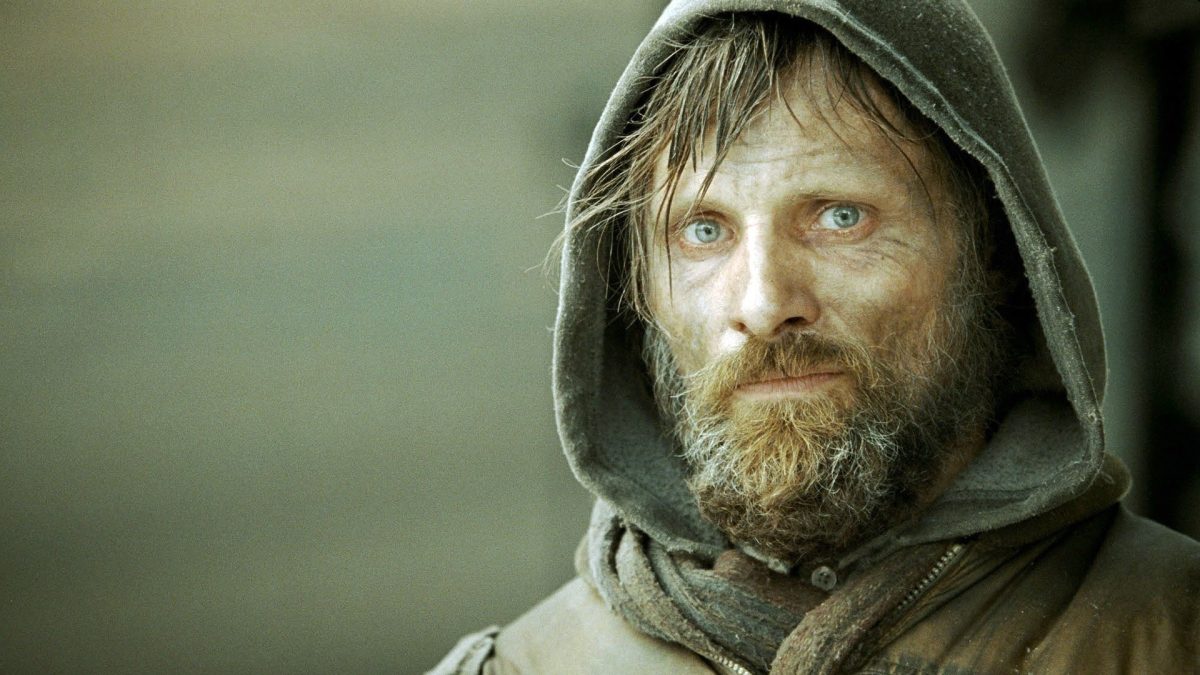
The Man is played by Viggo Mortensen with the kind of haunted intensity of someone who has stared long into the abyss and seen it waving cheerfully back. He is our theological guide through this wasteland. What he offers is a kind of inverted theology, a negative space where God used to be. He isn’t an atheist. Atheism needs intellectual energy in order to deny something, and this man is running on fumes. All he is is a father in a godless universe who is trying to keep his son alive for reasons he can just about articulate.
Now, the argument could be made, and movie scholars love making arguments, that the Boy is a Christ figure. And okay, sure, he’s innocent and concerned with goodness; he is carrying the figurative weight of humanity’s future on his narrow shoulders. But where “The Road” gets interesting, complicated in a way that makes you want to pour a drink and stare out the window, is when we realise the Boy isn’t Christ. He is what’s left when the Christ story stops making sense.
The Boy is constantly asking the Man if they are the “good guys”. He is obsessed with this taxonomy of good and evil in a world where such fine distinctions have become as quaint as thank-you cards or dental hygiene. He wants to help strangers. The Boy cries when his father acts with justified brutality. In essence, he is trying to be good in a universe that will give no reward for goodness. No cosmic accountant is tallying up his virtue for future redemption.
This is the most devastating theological statement in the movie. The Boy is the embodiment of all the principles we associate with religious teachings. There is mercy, compassion, and sacrifice in him. But it is totally divorced from any religious framework. The boy is good because…well, why? His father taught him? Is it instinctual? Even in a world of horror and ash, something in our humanity must insist on decency?
The movie refuses to answer. And that refusal is in itself an answer.
We have to talk about the cannibalism in the movie. In a movie about religion, cannibalism serves as the ultimate perversion of the Eucharist. “Take and eat, this is my body.” But here, it’s literal, with all metaphor and transubstantiation and theological gymnastics used to make cannibalism palatable to polite society stripped away.
The scene in the basement, the one that makes you want to shower in bleach, serves as the movies unholy communion. They aren’t sophisticated Hannibal Lecter types, pairing a nice Chianti with human flesh. They are people reduced to nothing more than pure appetite, with survival lacking any pretence of morality or dignity. These people are what we become when the social contract isn’t just broken, it’s burned for heat.
Must Watch: 10 Movies to Watch If You Liked ‘One Battle After Another’ (2025)
And what keeps me up at night about that scene is the fact that Hillcoat doesn’t judge them. Not really. He doesn’t need to. We do that ourselves with our visceral and immediate horror. The movie, however, presents them in an almost clinical style, just another response to the apocalypse. Some, like the Man, still cling to the old rules. Some, like the Boy, try to invent new ones. And some decide, in the absence of God, that anything is permitted. Including cannibalism.
It’s Dostoevsky’s nightmare made flesh, and it’s served here without garnish.
There is a moment that’s easy to miss if you’re not paying attention, if you’re distracted by the relentless grimness, or Viggo’s ever-more alarming cough, where the Man speaks to his dead wife. Not a flashback, but in the present, in his head. A one-sided conversation with a memory or a ghost, or maybe just the echo of his own despair.
This is what prayer becomes after God. Not directed upwards to some benevolent overseer, but more lateral, aimed towards an absent beloved. The Wife, played by Charlize Theron in scenes that seem like happy lies the Man tells himself, chose suicide over survival. She saw what was happening, did the calculations, and opted out. And who’s to say she was wrong? Who has the right to argue that’s not the most rational response to a world where hope has become a form of cruelty?
The Man’s memories of her have become almost a secular scripture, texts he insists on returning to even though they torture him. This is his religion now. The worship of what once was, elevating the past into something sacred, exactly because it’s irretrievable. He isn’t praying to God. He’s praying to Before.
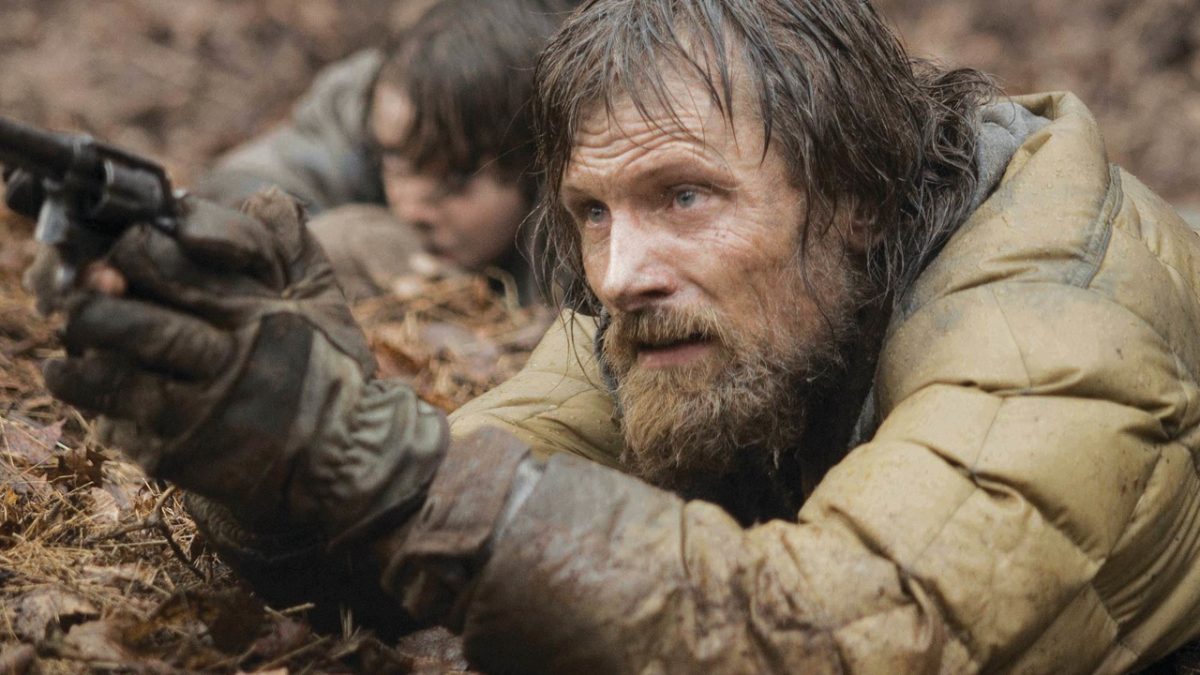
The most sacred object in the movie is the pistol holding just two bullets. The Man checks it constantly, with tenderness and more reverence than any priest handling the Eucharist. And what is it? Not hope, as that would entail more bullets, but a way forward. It’s an exit strategy. Murder-suicide as the ultimate expression of love.
Consider that for just a moment. The most precious thing the Man owns, the thing he cherishes above all others, is the ability to painlessly kill his son if things get too bad. That is his covenant, his way of saying “I will never leave or forsake you.” If necessary, I will put a bullet through your brain so you don’t suffer. This counts as love in the apocalypse. This passes for grace in a world without God. And the movie doesn’t flinch from it or try to soften it. Hillcoat, along with cinematographer Javier Aguirresarobe, films the gun in close-up and intimate detail. Making us look at it and understand that terrible intimacy.
Then we have the Old Man, played by Robert Duvall, with the exhausted dignity of someone who has lived too long and seen too much. He is the closest we come to a religious figure in the movie, and is basically a walking monument to the futility of faith. We learn his name, Ely, possibly Elijah. The prophet who called down fire from Heaven and ascended to paradise in a chariot.
This Ely has no chariot. He has bad eyes and dying flesh and the kind of bone-deep weariness that comes from having outlived meaning itself. His talk with the Man is the theological centre of the movie, a debate about God, spoken in whispers around a fire that barely illuminates the darkness. “There is no God, and we are his prophets,” Ely states with the certainty of a man who has waited for divine intervention and received only silence. It’s a line in which we can all recognise the bleakness and gallows humour, the recognition that we’re all just improvising meaning in a fundamentally meaningless universe.
The Man tries to challenge him, but he argues without any real conviction. For what can he say? Look around at all the evidence of God’s love? That argument dies before it can begin, suffocated by the total absence of anything resembling grace.
“Carrying the fire.” The Boy talks about it, the Man talks about it. It’s their shared mythology. A private religion built from scraps and desperation. But what is this fire? In the movie, it’s never explained or defined. But that ambiguity is crucial. Is it humanity? Consciousness? The capacity for love in a loveless world? All of the above, maybe? The fire is whatever you need it to be in order to keep putting one foot in front of the other. Religion as pure utility and belief as a survival mechanism. We have to believe, not because belief is true, but without it, we would lie down in the road and let the darkness overtake us.
Also Check: 5 Films to Watch if you like Mother/Android on Netflix
And the thing about fire is that it consumes. It destroys as it illuminates. The world of “The Road” was clearly destroyed by fire, whether climate, nuclear, or whatever. The fire giveth and the fire taketh away. We carry it and carry the thing that killed us. We are holding onto the very force that devastated civilisation. It’s the final paradox, the Möbius strip of post-apocalyptic theology.
If you haven’t seen this cinematic gut-punch, I’m going to spoil the ending here just a little. And so let’s just say that the movie’s final moments offer what could be interpreted as divine providence, as grace, as evidence that, after all, there is something watching over us.
Or.
Or it’s a random chance. A coincidence. The universe’s version of a participation trophy; comforting yet meaningless. The family that finds the Boy could be angels, they could be the last decent people, or cannibals who are just better at P.R. The movie doesn’t say. It can’t say. That uncertainty is exactly the point.
This is the modern religious condition in a miniature form. We are offered something that may be grace, and we must choose to believe it or not, all the while knowing that our choice doesn’t change the objective reality of what it actually is. Faith isn’t belief despite the absence of evidence; it’s belief despite the ambiguity of the evidence.
I’m going to cheat a little here and describe the very last image of the book because it just killed me when I read it. It’s of trout in a stream, their backs covered in “vermiculate patterns that were maps of the world in its becoming.” It’s the only moment of pure beauty in all the constant desolation, a vision of life before the fall. Eden, before we fucked it all up. It’s a dream, or a memory or maybe just McCarthy/Hillcoat reminding us what we’ve lost.
So what are we left with? What does “The Road” say about religion? Everything and nothing. It tells us that God is dead, or absent, or never existed. But we create meaning anyway, in defiance of the void. It tells us that love may be the only sacred thing left, and even love has become something twisted that contemplates survivalist brutality and mercy killings.
It tells us that in the institutional sense, religion is a luxury of stable civilisations. But religiosity, that yearning for meaning, the desperate conviction that we are more than just clever apes heading for extinction, that’s hardwired in us, part of the operating system even when the hardware is failing.
Watching “The Road” reminds me of all those places where people had every reason to give up, to collapse in despair, and yet didn’t. People are still making music in war zones. Weddings are being celebrated in refugee camps. The human spirit is persistent in the face of overwhelming horror. Is that God? Or is it just us, foolish and stubborn and still magnificent in spite of everything?
“The Road” doesn’t answer. It just gives us a man and his son, walking through ash, carrying a fire whose warmth we never feel. Heading south to a coast that could be as dead as everything else. And yet, impossibly, this is a story about hope. Not a greeting-card type of hope. The other kind. The type that looks like madness from the outside and feels like survival from within. This is religion in the apocalypse. Not faith in God, but faith in the next step, or next breath. The next moment with your son. It’s not much. But in “The Road,” it’s everything.
And if that’s not worth carrying forward, well, just what is?



![KIMI [2022] ‘HBO Max’ Review: Cyber Thriller Presents Both Sides of the Technological Boom](https://www.highonfilms.com/wp-content/uploads/2022/02/KIMI-2022-768x432.jpg)