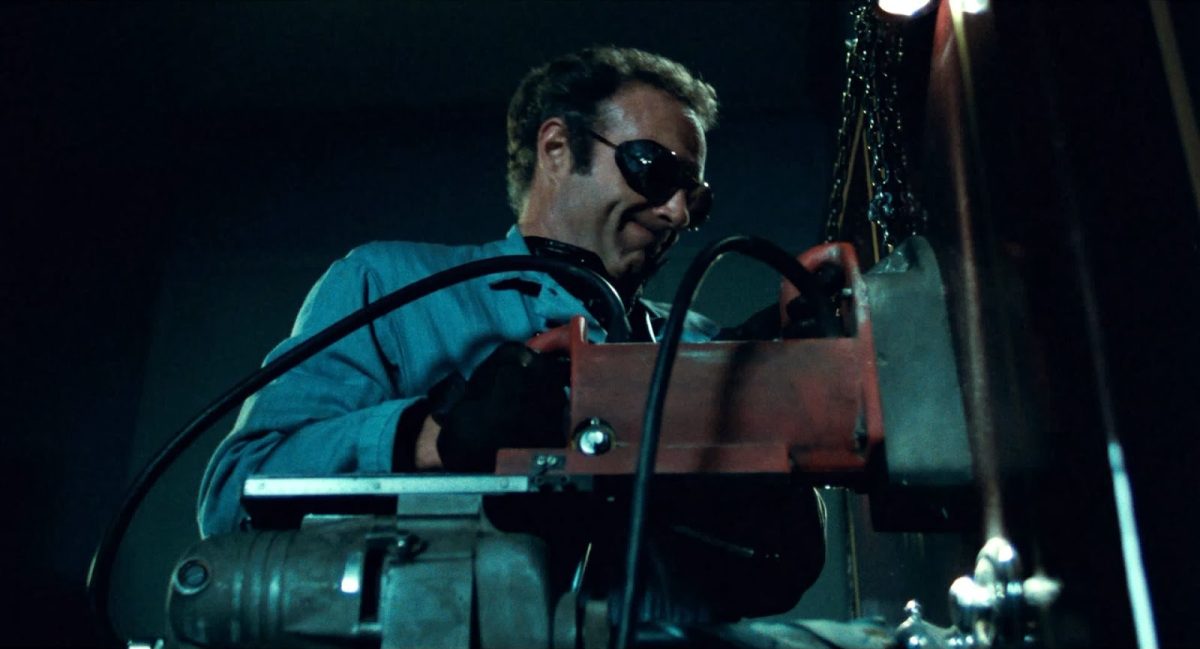
A tired silhouette first appears bent over metal with fire in his hands, with the sound of the torch against steel. The frame stays close to a man in his forties, absorbed in his craft, his body almost pressed against the surface before him. He watches it for a long time and works until the metal gives, never in a rush. The camera does not cut away from the labor, and by the time the safe opens, “Tangerine Dream” comes in. This is how we got a thief.
“Thief” was Michael Mann’s first theatrical feature, released in 1981. The director, who would later make films like “Manhunter” (1986) and “Heat” (1995), drew in part on Frank Hohimer’s memoir “The Home Invaders.” The book is shaped by the labor and unstable life of a professional burglar. James Caan, who plays Frank, our anti-hero, learned enough of the trade to make the labor look practiced, and plays the role without trying to give it glamour.
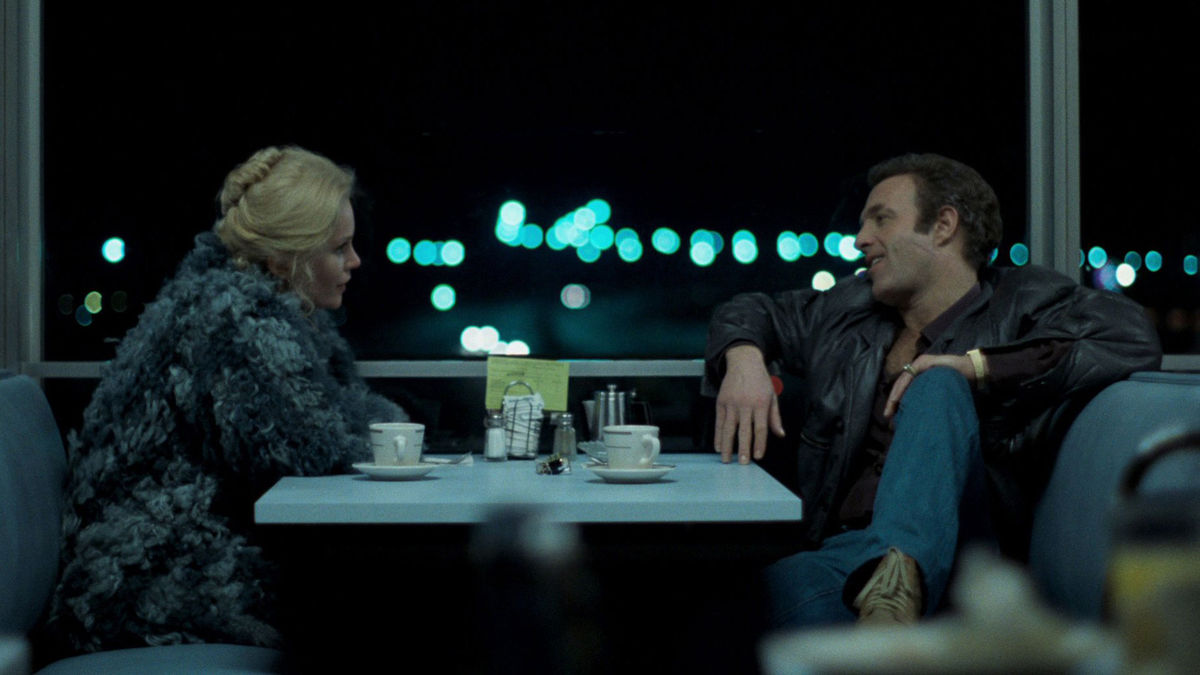
Sitting across from Jessie in the diner, Frank is trying to imagine a life that might finally hold. He talks about family, a house, and some future he still thinks he can build through the work of his own hands. Jessie is the waitress with whom he thinks that the future might still be possible. From the moment he starts describing his visions, he makes them sound painfully uneasy, going back to money and to what things cost, as if a life could be secured the way he plans a job.
As the film goes on, Frank keeps looking for a way out of the years of crime and prison and still imagines reaching it with the same tools this life has put in his hands. What he cannot quite imagine is getting there except by skill. There is already a figure for that kind of confidence in classical literature. In Homer, the foundational poet of Greek epic, the figure is Hermes, an Olympian god associated with thieves.
In the “Homeric Hymn to Hermes,” the Olympian is barely in the world before he is already making trouble in it. Born to Zeus and Maia in her cave, hidden from the other gods, he is out before night, driven first by hunger, looking for Apollo’s cattle. He seizes his half-brother’s herd as a chance to prove what his wit can do, to force himself out of obscurity and toward a place among the great Olympians. Hermes cuts fifty head from Apollo’s herd and drives them backward so the hoofprints point the wrong way, after hiding his own trail under makeshift sandals woven from branches. Frank works with that same trust in cunning, rather than putting his faith in any divinity. Hermes even offers a sacrifice to his father from the stolen cattle, yet the act still carries the same belief that drives the theft: trust in his own power to rise.
Hermes is also a psychopomp, a guide of souls who crosses from one realm to another and escorts the dead beyond the boundary the living cannot cross for themselves, from the Styx River to Tartarus or Champs-Élysées. In a wider view, among the Olympians, he is the god most deeply tied to movement, anointed the messenger of Zeus. In Hermes, passage feels less like an attribute than a condition of being. Crossing is the work that has been given to him, and the speed we associate with him belongs to that work before it belongs to style or ornament. That burden shapes him, and there is no final freedom waiting for him on the other side: he doesn’t even need it. Theft is part of the deal, certainly, but it sits inside a life inextricably bound to errands.
In parallel with “Thief,” Michael Mann chooses to illustrate this conflicted relation between freedom and enslavement to a way of life that both sustains a man and imprisons him through a new work relation. Faced with an impossible diamond heist, Frank makes a deal with the head of a local mob in order to outsource his labor, forging from that moment on a work relationship marked by obligation and by a boss above him. The payment is astronomical and would be enough for him to retire at last, so the change initially seems welcome.
Yet he finds himself caught inside a new order and even farther away, since even after carrying out the heist with perfection, he becomes too valuable to be let go by his new employer. For much of the film, Frank moves like a man who answers only to his own skill. He opens what should stay closed, and stays calm when other men would break. Now he reveals his price, and the exact thing that made Frank seem separate from everyone else is what makes him useful enough to be owned. A man who wanted to live above the law finds himself pinned inside another structure that also decides what his skill is worth.
John Locke, in his most influential work, “An Essay Concerning Human Understanding” (1690), treats liberty as a power bestowed upon man rather than an inward feeling. A man is free only where he can actually do or forbear what he wills. Frank can will another life, imagine it with precision, even describe it across the diner table as if speaking it clearly might help him taste its delights… and none of that is enough. Locke cuts through the romance of desire, insisting that wanting, per se, is not freedom. Even choosing in one’s own mind is not freedom if the conditions of action have already been narrowed by forces stronger than the will. Frank keeps discovering that gap the moment he has an intention, but lacks unclaimed ground on which that plan can become a life.
Hannah Arendt, writing much later in “The Human Condition” (1958), makes the problem harder in another way. Arendt does not speak of all human activity as if it were equally liberating, but separates labor, work, and action. Labor is tied to necessity, work builds a more durable world of objects, and action belongs to the political realm, where people appear before one another and begin something new. Frank’s life is full of skill and effort without ever quite becoming free action. He labors, in Arendt’s sense, inside repetition and works because he handles tools with real mastery. What he keeps reaching for is action in the deeper sense: the chance to begin again.
From a Christian perspective, Frank becomes harder to look at because skill no longer passes for freedom. Augustine keeps returning to the wound in the will itself. In “On Nature and Grace” (c. 415), he says man is sufficient to fall by his own will, but not to return to righteousness without healing grace. The will can ruin a life and still be too weak to restore it. Calvin, writing more than a thousand years later in the final 1559 edition of the “Institutes of the Christian Religion,” presses on the same nerve when he warns against trusting “the powers and resources” of free will. Frank wants out, but he wants out by the same means that made him, still trusting his own way of reading resistance and forcing a way through it. Augustine would see a wounded will still trying to act as its own physician.
Accordingly, the biblical language behind Augustine and Calvin is full of warnings against exactly this kind of inward reliance. “Trust in the Lord with all your heart, and lean not on your own understanding,” says Proverbs. Jeremiah goes further and says the heart is “deceitful above all things.” Paul, in Romans 7, gives the whole problem its most naked form: “what I want to do I do not do.” Frank is not quoting scripture, of course. Mann does not turn him into a sermon, but the shape of the struggle is familiar all the same.
Michael Mann keeps his protagonist acting as if enough intelligence, enough control over material and timing might amount to redemption. “Thief” keeps moving toward the same hard recognition: a man may know how to master fear, and still remain helpless before the deeper structure of his own bondage. Frank wants deliverance, but he wants it through Frank.
Thus, Mann keeps the whole argument tied to the image. “Thief” is full of hard surfaces and reflective ones: steel doors, glass, chrome, wet streets, showroom windows, and the glow of neon lying over all of it. Frank is framed against things that have to be read, tested, cut into, or passed through. Interiors feel sealed, and exteriors, especially at night, look open for a moment and then close again under light. Even the brightness of the film works that way. The city promises passage, and the frame keeps reminding us that passage has to be made. The clean lines of the city all carry a lure of freedom, yet Mann keeps placing Frank against barriers that divide one side from another.
In the scene of his greatest job, Frank sits down, his face dark with soot, lights a cigarette, and looks at the impossible safe he has opened. The feeling is way more than satisfaction, closer to self-recognition. For a moment, he seems fully at home in what he is. The job is over, and Mann lets the moment breathe. Before “Thief” turns toward family or betrayal, it is already fixed on passage. What does it take to enter a protected space? How do you pass through a world built to keep you out? By this point, Hermes starts to look like one of the shapes Frank has been carrying all along without knowing it. The man of crossings, not just the thief. The criminal whose gift keeps him in motion and never quite lets him arrive. Hermes belongs to the passage, so fully that the passage becomes his nature, as Frank keeps chasing it as if it were a way out.
By the end, Hermes sits much closer to the center of “Thief.” Frank wants a place where his life can stop being provisional, more than any amount of money, and that is what keeps slipping from him. Hermes helps name that condition because he belongs, more than anything, to the in-between. He can do what life in between demands of him, and none of it gives him a settled dwelling. Seen this way, Frank’s tragedy is that his power is fitted to thresholds.
The moments when he is most fully himself are the moments that confirm he belongs to passage more than to arrival. Mann lets us admire Frank without lying about what that admiration costs. Seen through Hermes, Frank’s talent begins to harden into fate, along with the loneliness inside it. He discovers, too late, that the thing in him best suited to the world is the very thing that keeps the world from ever becoming his.