
People tend to draw a line between what can be defined as fiction and what can be defined as non-fiction. However, the distinction isn’t always as clear-cut as it is made out to be. Whether you’ve invented a reality out of your imagination or recorded one with a purely journalistic approach, the eye behind the camera makes a ton of difference. The person shaping the story is essentially restructuring the nature of reality, molding it according to their socio-cultural backgrounds. That’s why either form can offer a point of view that has not been explored or considered before.
That makes Christopher Radcliff’s “We Were The Scenery” a fascinating time capsule. Written by Cathy Linh Che, the 15-minute-long documentary offers a closer look into the lives of her parents, Hoa Thi Le and Hue Nguyen Che, who had to flee Vietnam after the 1970s war. After leaving their homeland, they arrived in the Philippines to find themselves playing background extras for a Hollywood action blockbuster directed by an Oscar-winning director.
This stranger-than-fiction story is revealed through their recollections of working on set as refugees. Later on, they arrived in the States and settled, raising their future generation away from the uncertainties of their past. That, however, doesn’t take away the fact that they worked on Palme d’Or-winning “Apocalypse Now.”
The film, since its 1979 release, has been revisited and reinterpreted numerous times. Some consider it an anti-war film for analyzing the brutalities of war, while others believe it simply glamorizes the violence to fit into the mechanisms of a nail-biting actioner.
The latter assumption doesn’t seem far from the truth since in “Hearts of Darkness,” the documentary about making this feature film, Francis Ford Coppola briefly mentioned his willingness to bring elements of thrill every few minutes to keep audiences glued to the screen. That may have been because he had poured so much money into this project, much of which was from his own assets, that he needed it to be commercially successful, not only critically acclaimed.
Coppola, by then, was already the writer-director of two “Godfather” films and a Palme d’Or-winning film. Therefore, his artistic integrity may have also been on the line with this war film. “Hearts of Darkness” conveyed the push-and-pull inside his mind, based on the behind-the-scenes footage shot by his wife and creative partner, Eleanor.
She captured it all without any deliberate intervention into his creative process and without ever questioning his artistic genius. Hence, her footage is imbued with an unbiased journalistic approach, which, with further direction and editing, became an evocative portrait of Coppola’s creative crisis.
“We Were The Scenery” takes a different approach to reveal the behind-the-scenes chaos that unfolded during the shoot. We learn about that time from people who were partaking in that high-stakes reality shortly after fleeing their own. Back then, Coppola wanted the film to reflect not only the brutal insanity of the Vietnam War but Vietnam itself. So, in his film, we witness a fictional narrative hoping to reflect the truth, while reimagining it in another land, the Philippines.
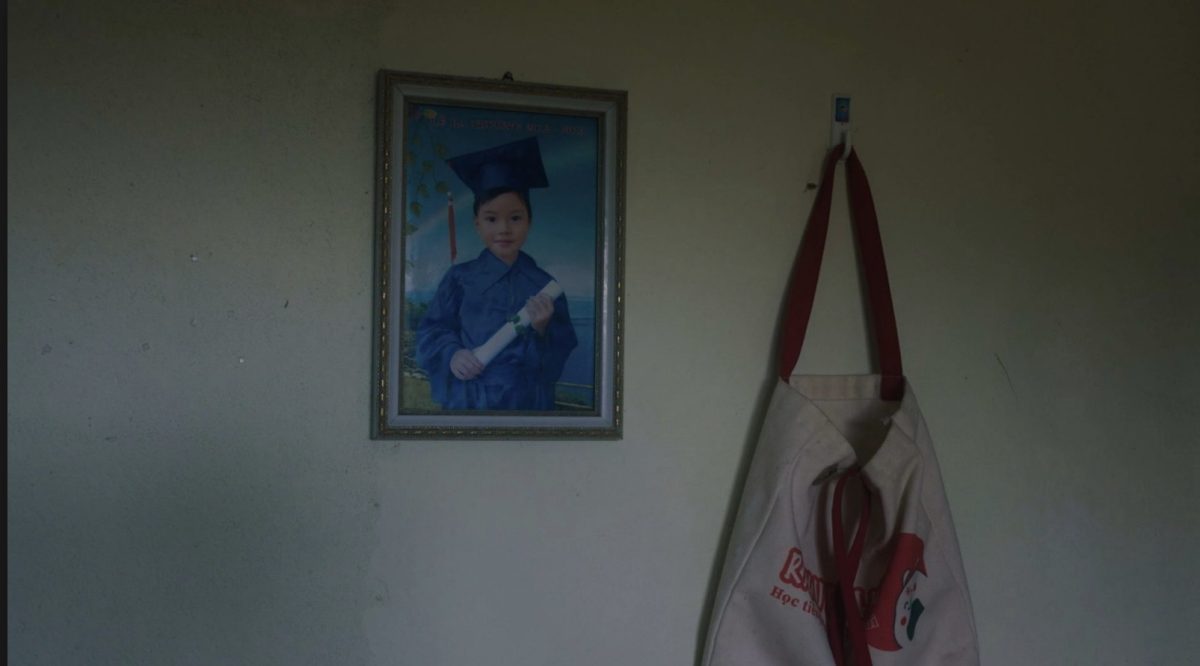
For him and for other Americans arriving there, the shoot may have been an opportunity to experience the brutality from up close. So, some of them may have simply been there to chase the thrills or face of the evil, some were immersed in the creative side of it. Whether Martin Sheen, Marlon Brando, or Coppola himself, the film took them to unseemly places, forcing them to confront their inner demons, occasionally resurrecting them to present the truth.
That isn’t the case for the couple we meet in Cathy Linh Che’s short film, who couldn’t opt out of the brutality because it was discomforting. They had to find a way to survive and make the most of any opportunity that came their way. Coppola’s film happened to be one of them, where they saw the movie-making magic in person.
Unlike viewers who find the lines between reality and fiction blurred in Coppola’s audaciously crafted audio-visual gamble, the couple doesn’t find it realistic. Che’s mother says so in Radcliffe’s short, as she recalls how the bomb blasts were executed in the film.
For someone who had lived through violence as an inescapable reality and witnessed its effect on her neighbours, violence is bound to be perceived and interpreted differently than the audiences simply experiencing it on screen or the crew trying to reinvent it as visitors and outsiders. That’s what makes Radcliffe’s short an intimate portrait of a hitherto unseen on-set experience.
It brings us back to the aforesaid detail about one’s perspective shaping the narrative. In the short film, we learn about it from voices who were simply ‘the scenery,’ as the drama was focused on the ethical and moral dilemma of Americans and was steeped in their ill-defined ideas about foreign cultures. The short film flips the gaze, offering observations about American observers.
In line with this, Che’s father shares a hilarious anecdote about the way Coppola ate mangoes, strange to them but not to the director. It becomes part of this tender time capsule that takes one step toward giving a more rounded understanding of this five-decade-old war and its residue on a personal level for the Vietnamese refugees.
Radcliffe, who also edited this short, paired clips from Coppola’s film featuring the extras, along with grainy VHS footage of Che’s childhood, and the present-day footage of her parents’ life in the States, gorgeously shot by Jess X. Snow.
Despite the gloomy narrative beats analyzing the contemporary political undercurrents between the refugees, the Viet Cong, and the Americans, the film maintains a warm and comforting tone, buoyed by an endearing narration from Che’s parents. The couple breathes life into this historical account that conveys plenty within a short span, while offering a side of the story that has rarely been explored on celluloid.





![Avengers: Endgame [2019] Review – A fitting finale and a poignant farewell for the superheroes](https://www.highonfilms.com/wp-content/uploads/2019/05/Avengers-Endgame-High-On-Films-2019-768x349.jpg)
![The Pianist [2002] Review: A Poignant Commentary On the Horrors of the Holocaust](https://www.highonfilms.com/wp-content/uploads/2019/07/The-Pianist-highonfilms-768x417.jpg)

![Army Of Thieves [2021] Netflix Review – A Bland Prequel To Zack Snyder’s Army Of The Dead](https://www.highonfilms.com/wp-content/uploads/2021/10/Army-of-Thieves_20201112_Unit_11074_R-768x512.jpg)