This is a Comparative Look at the 2006 cult classic, “The Prestige,” and the novel that inspired it.
Christopher Nolan is the Martin Gardner of the cinema, a master puzzle-crafter whose ultimate goal is to encourage us to exercise our problem-solving skills even as we’re being entertained. In some films, it’s not the destination but the journey that matters. In Nolan’s, it’s not the answer but the thinking process that’s essential. Regardless of whether he comes to an open or definitively closed ending, our concluding satisfaction comes from the mental workout he puts us through…most of the time.
Like most of Nolan’s films, “The Prestige” has developed a considerable cult following out of necessity, requiring multiple viewings to fully grasp all the intricacies and knottings of the storyline. Whether one wants to watch it as many times as necessary is another question completely. You don’t really want to see a magic trick again once you know how it’s done.
Although handsomely mounted and intermittently entertaining, “The Prestige” remains one of Nolan’s lesser projects to date. His direction is at its most ponderous, the dialogue by his brother Jonathan is often embarrassingly anachronistic (especially the exchanges between Christian Bale and Rebecca Hall), and the storyline, even though it jettisons much of the subplots of Christopher Priest’s source novel, somehow comes off as needlessly complicated in a way the book wasn’t. Whereas the twists and turns of the storylines in “Memento” and “Inception” were not only enjoyable but essential to understanding the story and themes, here they come off as ultimately frustrating distractions. So much for cinematic sleight of hand.
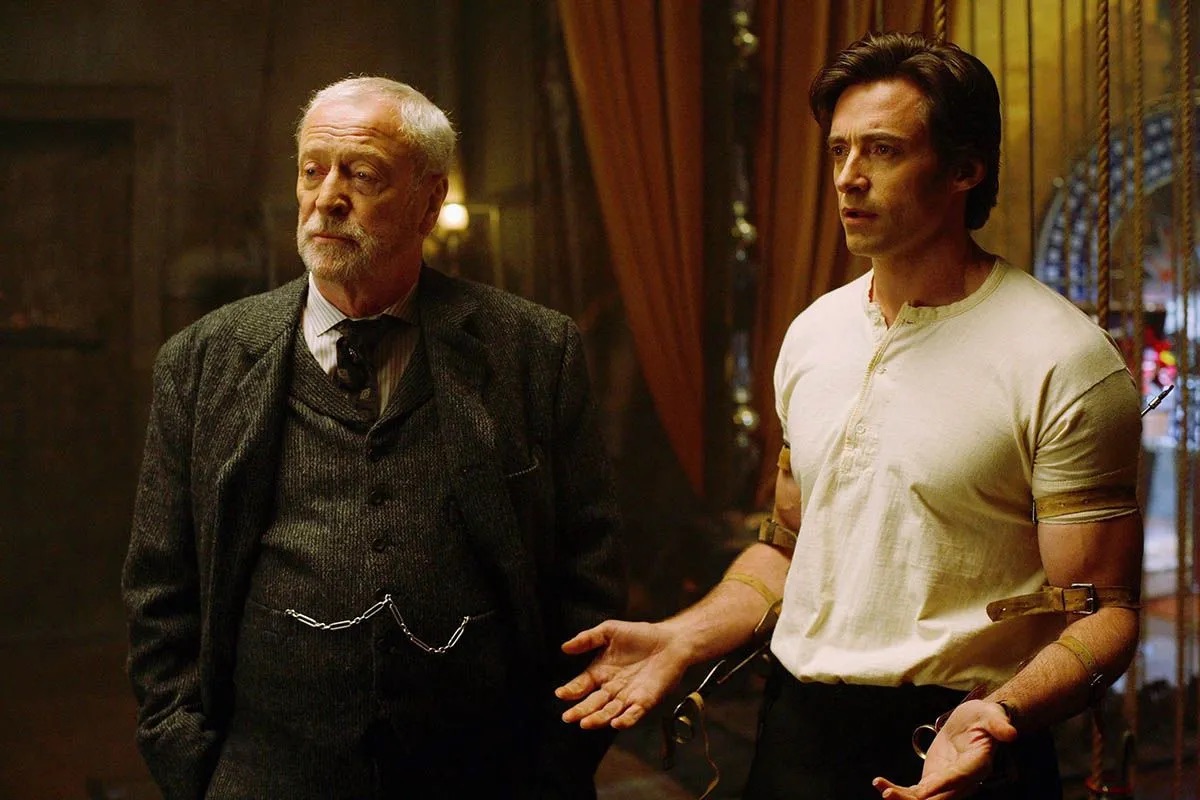
Perhaps the most disappointing aspect of the film is the performances, usually a strong suit in Nolan’s films. Except Michael Caine and, surprisingly enough, David Bowie (who’s a convincing Nikolai Tesla even if his accent sounds neither Serbian nor Croatian), none of them succeed at building up what are already poorly-defined characters that are given the simplest of motivations and tritest of relationships. Hugh Jackman, normally the most energetic of actors, is forced to restrain himself uncomfortably for most of the film, only coming to life when asked to perform a dual role.
In turn, Christian Bale, himself normally the most natural of performers, seems strangely ill at ease, delivering his dialogue in a halting tone throughout. Just because the character is supposed to be awkward on stage doesn’t mean he should be equally dull as a person. The actresses-Hall, Piper Perabo, and third-billed Scarlett Johansson- are wasted for the most part, with Johansson’s character practically disappearing before the film’s end, and not as part of the magic act.
Nonetheless, “The Prestige” still stands as an essential entry in Nolan’s oeuvre, one that must be seen in order to understand his evolution as a filmmaker. This is Nolan, still testing the waters of his talent, having dipped his toes with “Memento” and “Insomnia,” waded in further with “Batman Begins,” and now attempting to fully dive in with a lavish production that’s all his own, even if it is adapted from someone else’s novel. It’s a prelude to the much more successful and satisfying science fiction films “Inception” and “Interstellar,” where Nolan fulfils the pledge, skillfully accomplishes the turn, and the prestige is no disappointment.
“The Prestige” was adapted by the Nolan brothers from the 1995 novel of the same name by the late science fiction writer Christopher Priest, whose most famous novels were probably “Inverted World” (1974), and “A Dream of Wessex” (1977), the latter a tale of an artificial shared-dream reality that anticipated “Inception” in some ways, although the central premise was by no means an original one even then. This was not Priest’s first brush with the cinema; under a pair of pseudonyms, he had written novelizations of David Cronenberg’s “eXistenZ” (a quite appropriate match, actually) and John Badham’s “Short Circuit” (a very strange choice, to say the least).
Priest had earlier distinguished himself in the Seventies as one of the chief exponents of “New Wave” in science fiction, a literary movement that has deeply affected the evolution of the genre since, for both good and ill, to this day. Taking its name from the French nouvelle vague in cinema, and led primarily by other British writers, particularly Brian Aldiss, J.G. Ballard, and Michael Moorcock, it was intended as both a stylistic and political revolution, an upheaval intended to totally transform the genre and pull it up from its staid roots.
No topic or theme was off-limits, extreme stylistic experimentation was encouraged, and all taboos were to be discarded. Its proponents sought to expand the range of science fiction even if it meant a radical redefinition of the genre itself, and not surprisingly, it encountered equally fervent resistance from many longtime fans and writers.
Although Nolan’s “Interstellar” is “classical” science fiction in the Astounding/Analog tradition, a strong New Wave influence is evident in “Inception” and, to a lesser degree, “Tenet.” Hardware is kept to the minimum, and what little is on display comes off as almost cheerfully rudimentary.
While the fantastic elements may have a rational or naturalistic basis, there is next to no attempt to provide an explanation for them, and it will even try to brush away any actual connection to real science (one of the main reasons hostility towards the movement was so high among many longtime science fiction fans). Finally, and perhaps most importantly, in many New Wave stories the emphasis is on inner space instead of outer space, an exploration of the psychological landscape instead of the physical universe.
Related: 10 Best Christian Bale Movie Performances
“The Prestige” was first published long after the New Wave had arrived, crested, and finally troughed, yet Priest had stubbornly insisted on riding it out to the bitter end. It continued Priest’s ruminations on one of his favorite themes, the differences between surface appearance and reality, not coincidentally also core to the magician’s trade.
The novel tells its stories from multiple angles through no less than four different narrators, allowing the author to experiment with a variety of different styles, albeit without the flourishes that characterized the literary movement he belonged to. The Rashomon-style use of multiple unreliable narrators enabled Priest to create a literary equivalent to a magician’s sleight of hand, where one is never sure if an account is objective reality or pure illusion, and we keep switching sympathies as well as perspectives.
Although far more conventional than such wildly experimental works as the decidedly unfilmable “Inverted World,” Priest’s “The Prestige” still has fascinating layers of thematic and narrative complexity as well as strong characterizations that are sadly lost in the film adaptation. Priest’s story has the structure and feel of a John Banville novel, almost as if it were a follow-up to Banville’s “Revolution Trilogy,” this time at the dawn of the Electric Era. It also shares with Banville the theme of a search for truth and knowledge across generations, one which is sadly missing from the film (although curiously enough, it’s a major theme in “Interstellar”).
In addition to Angier and Borden, the narrators include their descendants, Angier’s great-granddaughter Kate and Borden’s great-grandson Andrew Westley. Both are not only trying to understand the feud between their ancestors but are also trying to solve personal mysteries that have tormented them for years. Resolving the one that exists between them also provides the solutions to their individual cases, providing a much more satisfying conclusion than in the film
Another major change made by the Nolans in their adaptation is that they’ve greatly simplified the motivations behind Angier and Borden’s feud. In the book, they simply begin with envy, but they escalate in cause, intensity, and justification. The reasons for their feud are clearer, more understandable, and significantly more relatable on a moral level. Borden moves from jealousy with his rival to outrage when he finds out that Angier has been using his magician skills as an afterlife medium, a clearly unethical violation of their professional code of conduct. Angier, meanwhile, is motivated by revenge when Borden’s debunking of his séance leads to the death of his unborn child.
Borden does not directly cause the death of Angier’s wife in a water tank trick as he does in the movie. Instead, he seems to nearly drown Angier himself during the same trick, and since the story at this point is being told from Angier’s perspective, his actual role in the mishap is ambiguous. At this point, Angier was ready to forgive Borden for the death of his child, but his own brush with death at Borden’s hands cements his conviction that they are locked in mortal struggle. The feud continues through the years, both men escalating the complexity of their deceits, both on stage and between each other, and later, their descendants, culminating in the seeming murder of Borden’s great-grandson by Angier’s son. Once again, however, all is not as it seems…
In comparison, the escalating feud between the two men in the movie is not just less drastic but, except for the aforementioned death of Borden’s wife, comes off as more petty. Angier shooting off Borden’s finger during a trick comes off more as just an excuse for a visceral shock moment than a viable establishment of the animosity between the two men.
It certainly doesn’t affect Borden’s skills as a conjurer (how and why he’s able to cope with this disability while performing is never satisfactorily explained. Having him exercise his hands by repeatedly squeezing a rubber ball is inadequate, to say the least), and it doesn’t figure in the story later except as a framing device.
The most drastic change the film makes is the simplification of the Reappearing Man device. In the film, it’s a simple duplicating device like that in countless other tales, making copies of people, cats, and (in a pretentious and all-too obviously symbolic final shot) a whole mess of magician’s hats. In Priest’s novel, it functions not unlike the device in Algis Budrys’s novel “Rogue Moon”: it not only replicates the person, but the original immediately dies while the duplicate, complete with all the memories and emotional responses of its template, takes its place.
Since Angier refers to the corpses the device leaves in its wake as “The Prestige Materials,” the book’s title takes on an added meaning not in the movie: it refers to not just both the final stage of the magical act and the high status in their profession that both men chase, but their basic humanity as well, which they reduce to a mere shell as a result of their pursuit of glory and perceived vindication.
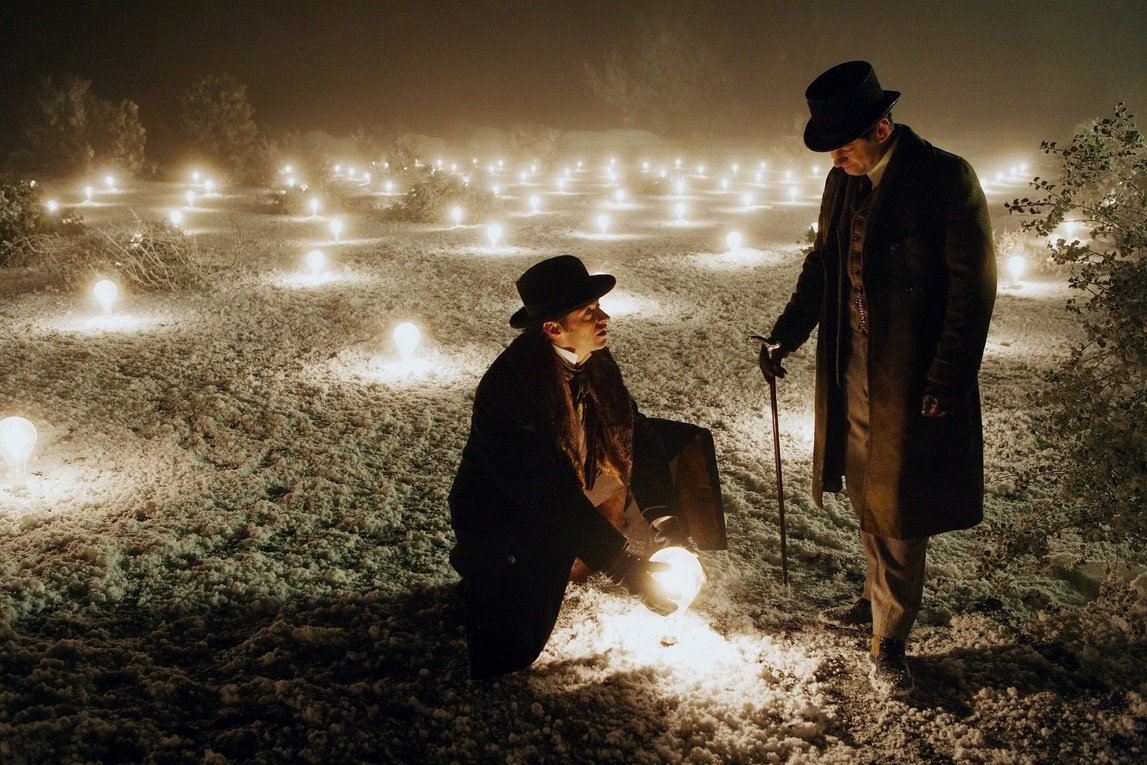
Literally so: when Borden sabotages his rival’s act, Angier is left in a sort of physical limbo, both original and duplicate existing simultaneously, the former wasting away physically while the latter remains in a ghostly, semi-intangible form. The “ghost” Angier finally meets up with the aged Borden years later, and initially tries to kill him, before being confronted with his renewed sense of morality and a realization of the futility of their feud and how it has destroyed both of them, in every possible way.
To make up for this change, the movie introduces a most implausible twist: the user of the duplication machine then drowns themselves in a water tank once the replication process is complete. Now, realistically speaking, even if you knew you were making an exact copy of yourself with all your memories and emotions intact, would you so cavalierly do away with yourself in such a messy, unreliable, and potentially painful way just for the sake of your art? Maybe some particularly desperate or daring people would, but the movie fails to convince us that either of these men in particular would do so. On the other hand, Priest convinces us thoroughly that the Angiers and Bordens of the book would be so ruthless that they would go to any means to justify their ends.
Then there’s the matter of the final twist, in which it is revealed that the Borden of the movie was actually a pair of identical twins all along. It comes off as unsatisfying and obvious, all the more so after reading Priest’s novel, where it’s an important motif introduced at the very beginning, developed throughout the storyline, and essential to an understanding of all the main characters as well as the main themes. Andrew Westley, the descendant of Borden, has long believed he must have had a twin brother he was separated from shortly before he was adopted and renamed.
He has no evidence, just a haunting suspicion that someone, somewhere, “was sharing the same life as me,” as he puts it. It is only at the very end that we learn that Andrew Westley is really the duplicate of Borden’s great-grandson Nicholas, the young boy Angier’s son seemingly killed when he tossed him into the machine, a revelation that ultimately provides closure to the magician’s descendants and puts an end to the generational feud.
Angier deduces early on in the book that Borden must have a twin brother that he uses to perform The Reappearing Man trick, but then dismisses this hypothesis when he’s unable to find any record of another Borden sibling. Not only does his initial hunch prove correct, but we learn that Borden had ruthlessly erased or altered all records of his brother’s existence, knowing that Angier and other magicians would try to learn his secret.
It’s another powerful revelation, not just because it demonstrates the extent of their obsessions, but how their own lives have become as illusory as their stage acts as a result of them, and that they have deceived their own selves as much as each other. Ironically, Michael Caine’s final narration in the film, where he speaks of the true prestige being “the return of what was thought lost,” applies much more to the book than to the movie.
I hope I have not been too harsh on the film, at least no more harsh than a responsible parent would be towards a misbehaving child. Since the release of “The Prestige,” Christopher Nolan has made one superb film after another, excelling at big-budget entertainments that are thoughtful, thematically profound, and demanding of intellectual engagement with their audiences. I have no problem saying that he is probably my favorite director currently working within the Hollywood system.
Perhaps then “The Prestige,” along with “Memento” (which holds up less on a third watch than it did on its first and second viewings) and “Insomnia” (his most forgettable film) as Christopher Nolan’s pledge to the audience a promise of something greater, and the “Dark Knight” trilogy as his turn, demonstrating a skill at grand entertainments under which pulses more thoughtful currents than the typical popcorn picture. With such triumphant achievements as “Inception,” “Interstellar,” “Dunkirk,” and especially “Oppenheimer,” all thinking-person’s epics made to challenge the mind as well as the eye, he has fulfilled his prestige in both meanings of the word. Now, we need only wait for his next act…