
You’d expect a film called “Butterfly Jam” to employ its title with some sense of metaphorical abstraction, but Kantemir Balagov’s English-language debut doesn’t play that way; this title is meant quite literally, and the context is given early on. Azik (Barry Keoghan, continuing to swing “father of teenagers” roles despite still looking like he’s fresh out of grad school), a Circassian-descendent chef living in Newark, hosts a restaurant owner acquaintance at a card game and invites him to try his sweet jam to go with his signature pancake-adjacent delens. The jam is a hit, and what’s the primary ingredient? Not grapes, not plums… but butterflies.
“You can make a jam out of anything,” Azik professes, as if expressing in his own words the patchwork spirit embodied by a film that, according to its director, went through innumerable changes before finally hitting the screen—everything from initially being set in Russia prior to the invasion of Ukraine, to an intended dance scene with New Jersey’s Circassian diaspora before they backed out at the last second over vague concerns about the film’s themes. You can, maybe, make a jam (or a movie!) out of anything, but that doesn’t necessarily mean it’ll come out sweet.
Azik is just one of several men who learn this lesson the hard way, but none figure more prominently than the chef’s 16-year-old aspiring wrestler son Temir (sturdy newcomer Talha Akdogan). Living with his widower father in a dingy Newark apartment as the pair work for his very pregnant aunt (Riley Keough) at the family’s Circassian cuisine restaurant, the ever-present ambition for something greater clashes not with the typical roadblocks of American discrimination towards cultural minorities, but rather by a culturally specific take on masculinity, and the debilitating insecurities of being perceived as weak.
It’s a problem afflicting pretty much any patriarchal society—and one which inspired Balagov to reach into his own Circassian roots and examine a male-centric dynamic as opposed to the women-centred stories of his two prior Russian features—but its centrality feels especially potent in the context of one of the more casually homoerotic sports since the days when sculpted olympians competed in the nude. Everyone in Temir’s family approves of—shows pride in, as a matter of fact—his aptitude for such a testosterone-fuelled activity, which includes a wily family friend whose grasp on his own masculinity is clearly the most radioactive (this man, Marat, is played by an unrecognizably beefed-up Harry Melling who damn-near steals the show).
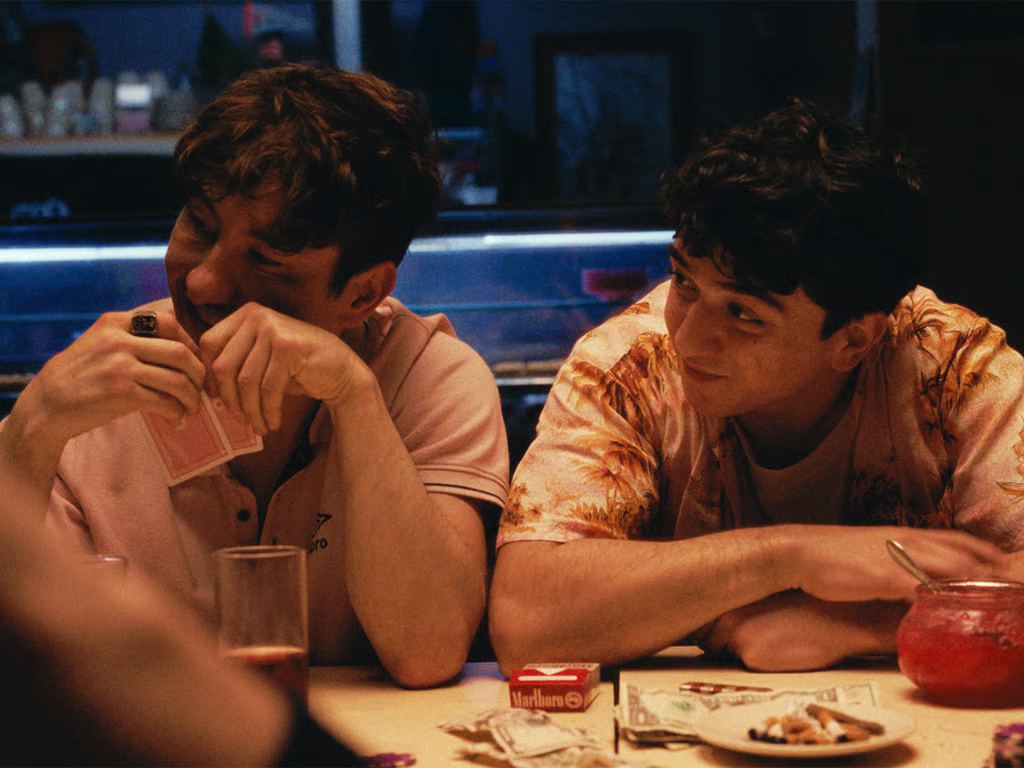
How these concepts are then rolled together into a piece of (very) lightly fantastical gendered commentary is where “Butterfly Jam” begins to lose its flavour, as Balagov and his co-scribe Maria Stepnova struggle to unify the perceptions of weakness with compensating behaviour that matches the urgency on display; Temir’s budding relationship with a fellow wrestler (Jaliyah Richards) ultimately leads to a revelation about her own insecurities that, by comparison to what he’s just been through, is borderline comical.
As much as Balagov wants to spray the Newark apartments (actually shot in France, as indoor US shooting proved far too expensive) with pink lighting to feminize the atmosphere—just as he showered “Beanpole” with fertility-ready greens—his ultimate desire to explore the value of vulnerability rings hollow in the context of a story that only really pushes the hyper-masculinity when the narrative needs to take a shocking swerve. It’s no spoiler to reveal that Azik will, at some point, die—the film’s very first scene is an in medias res snippet of Temir claiming his dead body—but how Balagov will wind up typing that knot leaves “Butterfly Jam” with an aftertaste too sour to let the eventual denouement reach its intended note of a hopeful seabreeze rolling in on the Newark beach.
The New Jersey Circassian subculture—seemingly the driving impetus for Temir and Azik’s struggles with frailty as Keough’s Zalya dominates what little crumbs of screen-time she’s afforded—itself never reaches much more than name-dropping status as a reference-point for a dish or two, and Balagov’s thriving commitment to his ancestry here reads very much like one handicapped in its initial attempts to tap back into the source by an ongoing invasion.
As “Butterfly Jam” persists in its strange mixture of grime and dashes of whimsey—I haven’t even mentioned the crucial plot-point of a kidnapped pelican—Balagov’s increasing stylistic alignment with Alice Rohrwacher begins to solidify itself where his film’s chosen tonal register begins to blur. (Casting Monica Bellucci as a vaguely mythic cultural presence? Where have we seen that before…)
Perhaps an Americanized Andrea Arnold might be a more suitable point of reference (Daddy Keoghan and all), but as his cohorts have proven the continued aptitude of women directors to deconstruct masculinity from afar, Balagov has curiously found himself on the opposite end of the spectrum, with far more middling results when he tries to meet his like-gendered subjects in the middle.



![The Hating Game [2021] Review: Promise Turns into Pity Sooner Than You’d Expect](https://www.highonfilms.com/wp-content/uploads/2021/12/The-Hating-Game-2-768x432.jpg)
![Lookback on Zanussi: Camouflage [1977]](https://www.highonfilms.com/wp-content/uploads/2018/03/Camouflage_Zanussi_HOF-768x463.jpg)



![Roots [2021]: ‘KVIFF’ Review – A Distinctively Minimalist Portrait of Landscape and its People](https://www.highonfilms.com/wp-content/uploads/2021/08/Roots-2021-768x403.jpg)