Ryan Coogler’s horror musical conjures a beguiling harmony from two old songs: vampiric rebirth and the blues guitarist who meets the devil at the crossroads. The result is an instant classic that somehow feels both contemporary and primordial. Perhaps that’s because myths about satanic Delta blues and Dracula come from a surprisingly similar place – the beginning. The very beginning, in the Biblical sense. Both narratives fundamentally retell the foundational myth of banishment and exile from the Garden of Eden, which echoes the Sinners’ concerns with paradise lost, the casualties of ambition, and the false promise of the American Dream.
Like their ghoulish villains, vampire films are an undying genre. This is partly because they reiterate a narrative that has shaped Euro-American culture for centuries. Like Adam and Eve, vampires are corrupted by Satan’s representatives into eating a forbidden food (human flesh) in exchange for godlike power/knowledge. However, this Faustian pact removes them from human society (the Garden) and introduces them to (un)death and perpetual suffering.
A related Eden spinoff is the tale of the Delta blues guitarist who meets the devil at the crossroads and trades his soul for godlike chops. Like Adam, Eve, and vampires, these guitar heroes typically stray far from their communities and lead tragic lives lost in spiritual wastelands of addiction and discontent. As usual, reality is more prosaic. The crossroads myth most likely comes from the phrase “selling your soul to the devil”, which was applied to Delta blues musicians who “sold out” by abandoning religious music (the Garden) for secular songs (forbidden fruit).
Ryan Coogler’s latest feature could be called Original Sinners – after all, the first villain its heroes vanquish is a serpent in an idyllic grove. But like the best vampire films, “Sinners” injects new blood into these old myths, using them to examine contemporary choices between power and community, wealth and sustainability, and to compare the lens of critical race theory with post-racial ideology.
These lines are drawn from the first scenes, where Smoke and Stack, twins and WWI veterans, return to their hometown with newfound wealth and plans to increase it by establishing a gambling den and music venue. These brothers are firm antiheroes. Although charming and sometimes kind, they use their money to coerce the Black townsfolk into doing their bidding and to excuse their abusive acts.
For instance, when Smoke catches a couple of bedraggled men rummaging in his car, he maims them to uphold his reputation, before handing a shopkeeper a few notes for their hospital bills. Similarly, Stack verbally abuses a man’s wife before buying forgiveness with a job offer. This begs a question: who are the real vampires?
After all, vampires have always encapsulated collective anxiety about economic elites, like the freshly minted Smoke and Stack. From Dracula to Twilight, vamps are almost universally wealthy and control the actions of those around them. This is no coincidence – as with bourgeois bankers, feudal landlords, or gambling den operators, they derive their power parasitically from the peasantry. This dynamic is what led Marx to write that ‘Capital is dead labour, which, vampire-like, lives only by sucking living labour’. The supernatural frills are just an aesthetic representation of this everyday dynamic. Vampires are our fears of economic exploitation made manifest.
Given Smoke and Stack’s vampiric attributes, it’s unsurprising that they meet their match in a trio of white vampires, drawn to the new venue by Cousin Sammie’s supernaturally good guitar playing. These are the centuries-old Irish Reddick and his two Klan member recruits. As with almost all vampire narratives, their supernatural abilities are conflated with capitalist coercion.
The trio tempts Stack’s ex-girlfriend, Mary, with a purse of gold doubloons before turning her. Whether it was ultimately the money or the fangs that got her doesn’t matter – they amount to the same thing. Undead Mary then shows these coins to the twins in an effort to gain admittance for the other vampires. Of course, these are the same tactics that Smoke and Stack have been using all along. In both cases, capital is a deadening force that turns those without it into thralls – labour to be parasitically sucked.
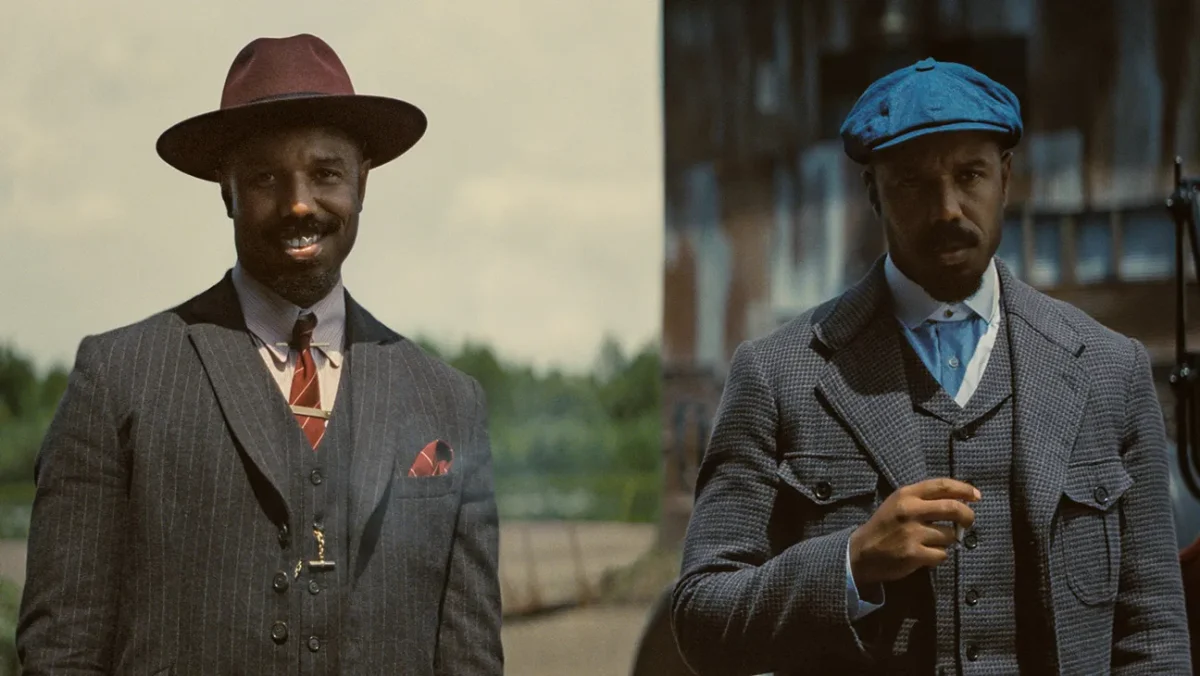
This lens allows us to see to the heart of Sinner’s central drama. Reddick ultimately wants to enter the club to harness the power of Sammie’s music by assimilating its players’ lifeforce. For the privilege, he is willing to offer Sammie immortality, riches, and freedom from racial oppression. Sounds a lot like the kind of deal companies like Chess Records began offering Black Delta blues musicians when they realised the commercial possibilities (It also sounds a bit like the deal Marvel might have offered Coogler to keep him locked in the franchise dungeon for the last five years). Spoiler alert: it’s a raw one.
But while “Sinners” spoon-feeds its audience elsewhere (enough with the backstories, Ryan), it’s much too smart to tell us in plain terms whether to choose vampirism or mortality. It presents immortal, “post-racial” vampirism as a utopian concept – at least on the surface – but like the best utopian blueprints, a fatal flaw is inbuilt to inspire thought and conversation about what a better system might actually look like. Here’s why you should choose mortal life:
Sinners’ vampires are telekinetic, with instant knowledge of each other’s languages and songs, i.e., cultural capital. The newly turned Black vamps promise the remaining humans that vampirism offers oneness with humanity and an end to racial oppression. However, simply swap living death for the capital it represents, and this becomes the false logic of the American Dream: sell your time to the highest bidder, and the proceeds will open an escape route from marginalisation. As in real life, this is all much too good to be true.
Like John Carpenter’s “The Thing,” which Coogler cites as a key influence for “Sinners,” assimilation with the vampires is tempting because it offers an end to the isolation of subjectivity, and true knowledge of others – a final escape from the mental prisons that hold us apart. But this is lent another dimension by the Deep Southern context of racial oppression. Because assimilation with the vampires’ hive mind means knowledge of all cultures. It also means an end to cultural differences and a relinquishing of cultural identity. It might be freedom of a sort, but only for a reformed Other.
This is especially clear when you consider the exclusively Scottish and Irish tunes that the multiracial vampire collective performs. The blues they played as humans are curiously absent. Songs of resistance to white hegemony have been traded for the music of the ruling power (even if, as Irish tunes, they once performed a similar anticolonial function). This device suggests that post-racial ideology really equates to forgetting about structural inequalities, rather than addressing them. The Black vampires might no longer suffer violent persecution, but their culture has been assimilated and disappeared under a white hierarchy.
This is the trade-off that “Sinners” is ultimately concerned with. For those existing outside capitalism’s inner circles of privilege, there is a very real temptation to acquiesce completely, to become a committed cog in a system pitted against them. But this involves a form of death. Allowing decisions to be dictated purely by the market’s highest bidder means shedding elements of cultural identity, like the capacity to engage in traditions of resistance such as the blues.
And in the end, it’s not blues music for which Sammie rejects immortal vampirism, but what it represents. In an unforgettable sequence where Black musics of past, present, and future meld into a soundtrack of the same party, it’s clear that this music holds the key to another, realer form of immortality – an eternal, shared tradition born of struggle and resistance, one that has defied the odds by continuing to draw breath. It might not offer riches, but it steadfastly refuses chains.



![No Limit [2022] Netflix Review: A Visually Arresting Sports Drama That Dives Into Obsession, Jealousy & Toxic Relationships](https://www.highonfilms.com/wp-content/uploads/2022/09/No-Limit-2022-768x432.jpg)