The hard-boiled detective is present in almost all noir films in some way, shape, or form. As the genre changes, I argue that it draws further and further away from the traditional masculine hero archetype, which may be more in line with our understanding of the American cowboy (e.g., John Wayne) or superhero (e.g., Batman or Superman).
While certain aspects of the detective carry throughout the genre—individualistic moral principles, a fatalistic outlook, and a distinct separation or alienation from modern society—the detective’s personal traits do change over time. Looking at Sam Spade in “The Maltese Falcon,” Detective Philip Marlowe from “The Long Goodbye,” Jack Gittes in “Chinatown,” and Rick Deckard in “Blade Runner,” it becomes clear that there is an actively changing masculinity in film noir.
In “The Maltese Falcon,” Sam Spade follows many traditional aspects of a hard-nosed, stick-to-his-guns detective with mostly traditional masculine features. This is accentuated by the portrayal of Joel Cairo, a caricature of a homosexual male, who is wearing a bowtie, has a cane, and sits with his legs crossed in such a manner that suggests, through subtle gesture, the stereotypical gay man, while adhering to the film production code of 1930.
Spade is extremely powerful with his smarts, and it makes him a very good detective. He is able to outshoot Wilmer Cook and outsmart the villainous crime boss Casper Gutman, and he is not afraid to break a few rules to do so. Ultimately, his “strength” is shown through his betrayal of the femme fatale, whom he is able to outsmart when he confronts Brigid O’Shaughnessy about how she killed Iva Archer to implicate Floyd Thursby.
Another very traditional aspect of Spade’s character is that he is known for having a wicked temper that often gets him in trouble. But the most telling aspect of Humphrey Bogart’s portrayal of Sam Spade and the nature of the detective’s masculinity actually lies in the way he interacts with Brigid.
While his inability to control his emotions may be his central weakness, he combats that by directly winning the battle with the femme fatale, who has little to no say in the matter, as she does not nearly match Spade’s smarts, and the control he has over the situation is the core of his masculine presence in the film. When Brigid is spinning her tale of lies in hopes of coercing Spade and keeping him from discovering the truth of the matter, Spade seems to know exactly what she wants.
Their relationship is a power struggle, and Spade is only interested when he is in control. In another traditional masculine archetype, he puts himself first always and is very detached emotionally. Right before they kiss for the first time, Spade states, “What have you ever given me besides money? Have you ever given me any of your confidence, any of the truth?
Haven’t you tried to buy my loyalty with money and nothing else?” Although Brigid may be flirting with Spade here in this scene, and successfully doing so, she is never the one in control of the dynamic. Spade holds it throughout the film, and keeps it in the film’s conclusion when he puts her behind bars. While Birgid did say he never loved her, the audience, in my view, can argue that he absolutely did love her, and his masculinity is portrayed through his ability to ignore his emotions to make the choice in the world of justice or what is right.
Also Related: The Representation of Women in Film Noir
But the image focus and impact of the hard-nosed, morally ambiguous detective changes during the course of the 20th century. The part in which this character facilitates or feeds the higher theme or purpose of the noir film changes during this time. A film that is notable for this transition is Roman Polanski’s 1974 Noir set in the underbelly of LA, “Chinatown.”
Like Spade, Jake Gittes is a detective who follows his own rules and is portrayed as an outcast from society. But during the development of the film noir genre, the power relationship changes between the femme fatale and the detective over the course of the 20th century. Films that we covered during the Queer Noir era, like “Laura,” “Mildred Pierce,” and “Gilda,” took a much different formula than the earlier noir films.
It saw a lot of females leading the way, and the power in the relationship between the femme fatale and detective swung towards the femme fatale. These were films with clear indications of female empowerment, such as Mildred Pierce’s clothing becoming more and more masculine as the film goes on to portray her independence and individuality, and in “Gilda,” the couple is able to get away with Mundson’s death without any further consequences, showcasing the power and influence of a woman like Gilda.
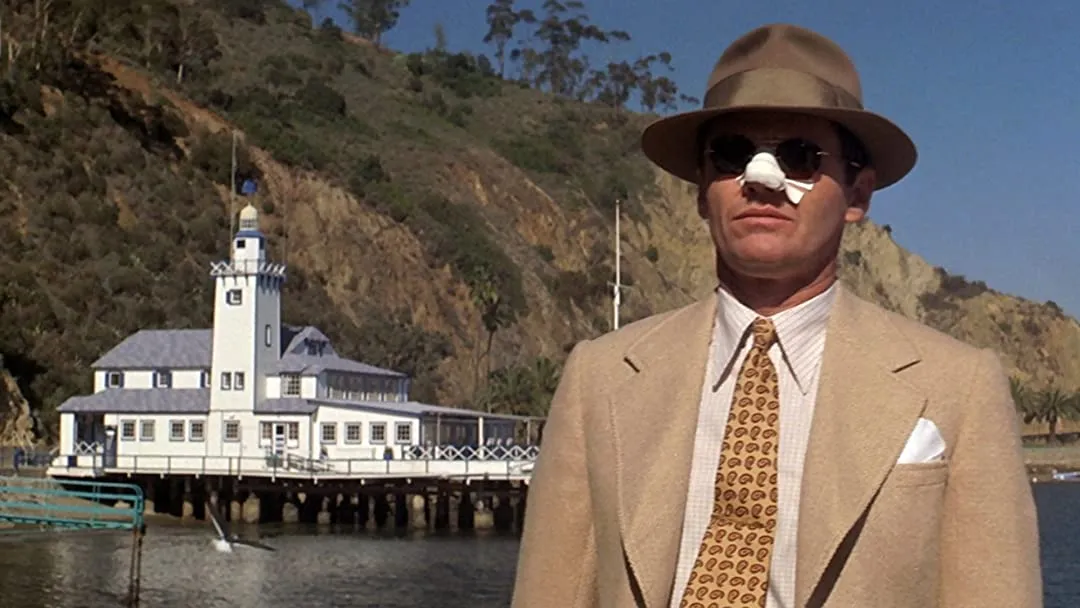
This is important when discussing the character of a man like Jake Gittes. Pretty much from the start of “Chinatown,” and certainly throughout the duration of the film, director Roman Polanski lets the audience know that Jake’s masculinity is impaired through the large bandage that covers his nose from the gash he had gotten. Like many noir detectives, Jake is held back by a checkered past, when he used to be a detective for the LAPD, working the beat in Chinatown, but his best efforts to help a woman were squandered, and he wound up with her getting hurt instead.
He is forced to relive his haunted past. This was a chance at redemption for Jake. Jake’s inner identity is in a constant battle. He mocks and belittles the work he and other detectives do, putting it down with cynicism as a way to cope with his own failures. But in reality, underneath the postering, as the film moves on, the audience learns that Gittes is a very good detective, and is invested in this case precisely because of what happened last time, and he sees through the actions and portrayal of Lt. Escobar what he could have been if he had chosen another path. He is a walking contradiction in what he believes in and what he projects, not being in line with each other. But despite his impaired and wounded face and the odds stacked against him, Jake continues to pursue the case.
Ultimately, Jake’s inner identity is represented through his actions in protecting these women, but what makes “Chinatown” a classic of noir films is the tragic ending. Not only is it dark, but it gives the audience the understanding that we have now witnessed Jake’s worst nightmare, a deja vu, and that there’s nothing to do about it.
The film’s final line “Forget it Jake, it’s Chinatown,” many take as a throwaway, but I see it as the last knife stab in the heart of detective Gittes for it is the acknowledgement that he is powerless over this situation, no matter how badly he wants to help, which falls very much in line with the theme of a deteriorating sense of control over a situation, which is so inherently masculine.
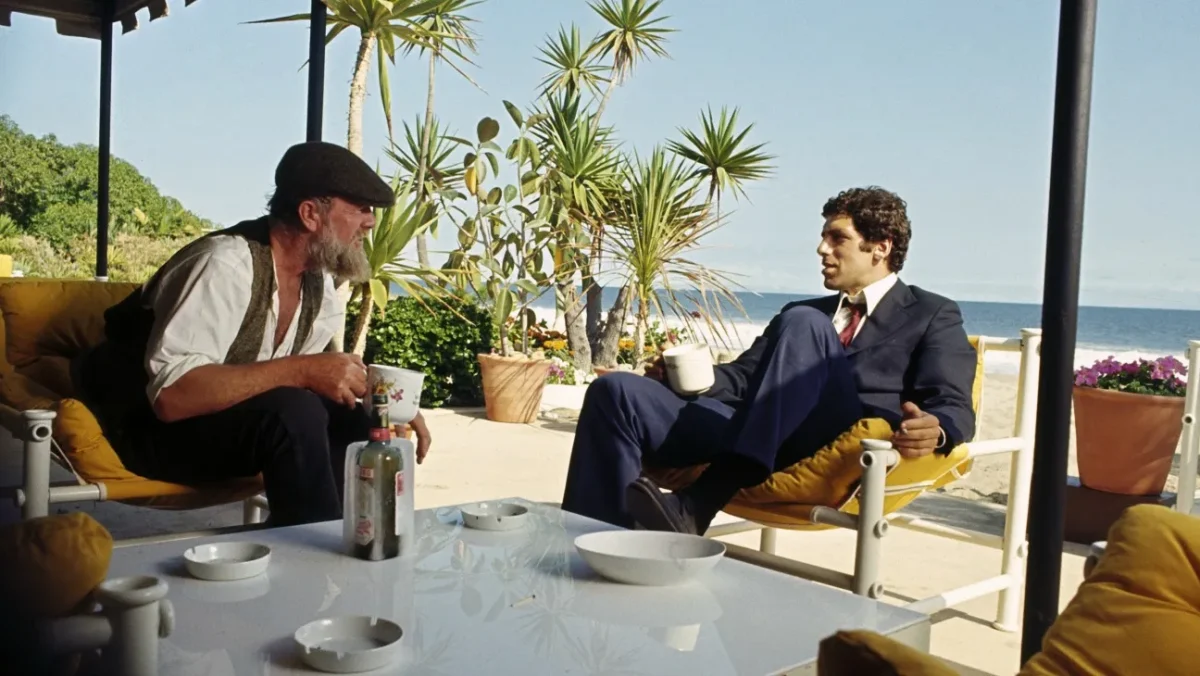
Another film that highlights the changes in the masculine identity of the hard-boiled detective in film noir is the 1973 Robert Altman film, “The Long Goodbye.” In it, we follow Detective Marlowe, played by Elliot Gould, who seems to be aimless and rather uninterested in just about everything. He lives alone with his cat and pays little attention to the pack of ladies across the way who are sunbathing every time he leaves his apartment. He is witty, has a dry sense of sarcasm, and feels very intentionally out of place. Even when Eileen Wade, a married woman, tries to seduce Phillip, Marlowe deflects all attempts, as he is largely uninterested in having an affair.
While You’re Here: 10 Great Film Noirs without Femme Fatales
Much like Jake in “Chinatown,” Marlowe is not a part of society and does not partake in the social norms that many might expect him to follow. Both Jake and Marlowe call upon their own individual ideologies. Many have compared Elliot Gould’s Marlowe to Humphrey Bogart’s Marlowe, in that of “The Big Sleep,” points out the stark differences in the detectives who essentially play the same character and are written by the same person, Leigh Brackett. But while the 1950s Bogart Marlowe uses his witty and clever one-liners and dialogue to intimidate rivals and get insider information, here Gould’s Marlowe does not have that luxury and is much more taken advantage of.
There is less of a mystery with this iteration of Marlowe. Gould plays him so that the mumbling dialogue is hardly heard by the audience. The interaction with his female neighbors and the early ten-minute sequence of Marlowe being forced to trick his cat into eating his food paints a picture of an extremely isolated and lonely figure who is sad, more sympathetic than mysterious, and in control. He is a moral romantic, which is exactly why it takes him that long to figure out that Terry was behind the whole murder, as his soft spot came for his love for his own friend.
This is where the line is crossed for Marlowe. He takes betrayal after betrayal, but the one he cannot go without taking action to address is the betrayal from his own best friend, a man he actually had helped facilitate getting away. This is precisely what makes Marlowe’s identity so human, without any faux masculine posing. He does not succumb to the wants and needs of others to the detriment of his own moral principles.
In the noir genre, the hard-boiled detective can often be seen as this rigidly principled yet flawed character, who is not affected by society or by the characters surrounding him. This is not the case with Gould’s Marlowe. He is unflinchingly human, and it is what makes him vulnerable, but also a great detective capable of solving the murder case.
Generally, the noir detective is seen as being cool and mysterious, and has an innate ability to discern what’s right from what’s wrong. But Marlowe’s humanity is exactly what undermines this classic film noir element. He makes many mistakes and misreads others, with the chief example being his best friend’s scheme that goes on right under his nose.